

 Share This
Highmark Bright Blue Futures is the organization’s charitable giving and community involvement program. This series provides in-depth articles on its work, community partners, and leaders as they advance their goals around Community Health and Community and Economic Resilience. In this article, we learn about The Food Trust, one of the organizations recognized by the Highmark Bright Blue Futures Awards Program.
The Highmark Bright Blue Futures Awards Program launched in 2023 to recognize nonprofit organizations for their leadership and exemplary programming. The Awards are an expansion of Highmark Bright Blue Futures, a corporate giving and community involvement program that works to ensure “healthier, brighter, stronger futures for all.”
The Awards, made possible by the Highmark Foundation, celebrate organizations throughout Highmark’s four-state health insurance footprint. In 2024, $490,000 in grants were awarded to organizations to recognize their impact in advancing health equity.
In this article, we profile a 2023 awardee: The Food Trust. For more than 30 years, The Food Trust has addressed the challenge of ensuring equitable access to healthy food in Philadelphia and surrounding communities.
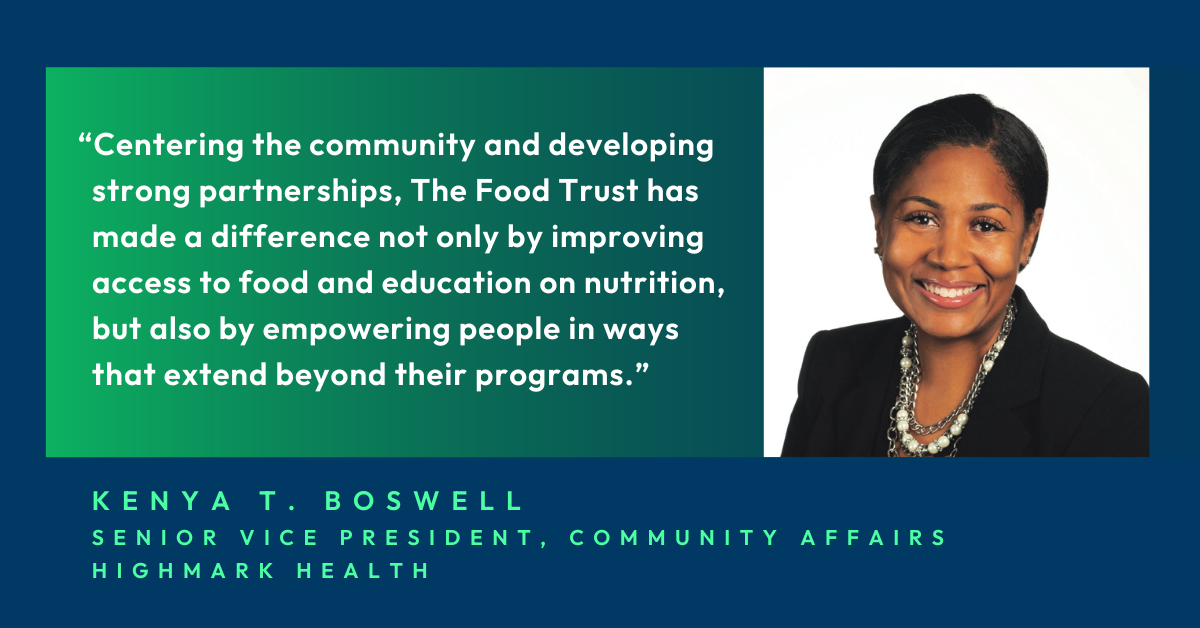
“The Food Trust has a tremendous reputation and deep understanding of their region’s needs,” says Kenya T. Boswell, senior vice president, Community Affairs, Highmark Health. “Centering the community and developing strong partnerships, The Food Trust has made a difference not only by improving access to food and education on nutrition, but also by empowering people in ways that extend beyond their programs.”
The Food Trust traces its history back to an insight at Reading Terminal Market, Philadelphia’s oldest indoor market, and a central part of city food shopping since 1893. In 1992, The Food Trust’s founder, Duane Perry, was a manager at Reading Terminal Market. He noticed that there wasn’t much fresh produce among the market’s offerings of meat, seafood, and specialty products crafted by the Pennsylvania Dutch community. In conversations with customers, he learned that very few city neighborhoods had a farmers market — so he launched one.
Then a couple more.
And now there is an entire farmers market network providing affordable, healthy food from 85 local growers and makers to more than 300,000 city residents each year!
Along the way, The Food Trust also expanded its work to nearly every area of food security and nutrition, but that initial insight and aspiration has remained the heart of its mission: delicious, nutritious food for all.
To promote equitable access, affordability, and education surrounding healthy food, The Food Trust has comprehensive programs in several key areas, including:

The Food Trust received the 2023 Highmark Bright Blue Futures Award for one of their most impactful programs: Food Bucks Rx. This innovative “produce prescription” program allows health care providers to prescribe fresh fruits and vegetables to their patients, complementing or even replacing traditional medication in some cases. The prescriptions — coupons or vouchers accepted at multiple locations — are integrated into community health hubs, promoting long-term behavioral changes in shopping habits.
Julia Koprak, The Food Trust’s Director of Incentives, Healthcare and Policy, leads the Food Bucks Rx program. She says that the response from people who get a “healthy food prescription” is consistently very positive, and emphasizes that there is a sense of empowerment and autonomy that comes with removing cost barriers and giving people the means to make healthier choices. She says that the program also strengthens the patient-provider relationship, building trust and fostering a more collaborative and holistic approach to health.
“Food Bucks Rx gives providers another way to help their patients, and it becomes part of the path to a more meaningful, trust-based relationship,” she explains.
Food Bucks Rx is just one example of The Food Trust’s role as what Koprak calls “a connector,” pulling together different parts of the food ecosystem to improve access to nutritious food. As was true right from the start, that includes identifying and addressing challenges of geographical access. In many neighborhoods, Koprak points out, getting to a store or market with high-quality, fresh produce might require multiple public transportation trips or an expensive taxi or rideshare. As a result, people opt for whatever food is closest and most convenient — unfortunately, that is often less healthy, processed foods.
“Our organization works closely with farmers, markets, and retailers — especially smaller, independent businesses — treating them as partners, and ensuring that funding supports local economies,” she says. “Expanding access to healthy food can benefit everyone involved.”
So, my name is Julia Koprak. I am the associate director of nutrition incentives at The Food Trust, and I’ve been with The Food Trust for 12 years.
Our mission is delicious, nutritious food for all. We rely on a central belief that no one should have to choose between eating healthy and eating enough. That looks like a number of different things, all with a goal of helping people eat healthier.
The Food Trust Food Buck Rx program is a program where providers can “prescribe” fruits and vegetables for their patients. So, providers give coupons that are redeemable at nearby retail settings. This brings autonomy to a patient. On the backend, we can tie these redemptions back to patient outcomes. So — consumption of fruits and vegetables, and other clinical indicators. The Food Bucks Rx program has a growing evidence base — it’s been proven to increase consumption of fruits and vegetables. More importantly, we see this better engagement between patient and provider, because the provider is able to give this immediate resource.
A lot of the work that we do is behind the scenes, creating this infrastructure. So to be able to provide the joy of eating fruits and vegetables to more families is really rewarding to The Food Trust.
Dig beneath the inequities in food security and nutrition and you’ll find a complex tangle of challenges, many of which have existed for generations. The Food Trust hasn’t shied away from that complexity, and is always looking at how it can have a deeper, longer-term impact.
“We don’t want to do things that are one off,” Koprak says. “At the same time, we must often balance acting quickly to address emergent needs with acknowledging what has to be done to create a more sustainable long-term solution.”
She cites the technology challenges around Food Bucks Rx as one example of something that requires more long-term problem-solving than people might realize. Using coupons and vouchers might sound pretty straightforward, she says, but the organization has had to be creative in developing a system that works for a broad range of farmers, grocery stores, and individuals. Some partners need coupons to be scannable, for example, while others don’t have the ability to scan at all. In some cases, card vouchers have been necessary instead of paper vouchers.
Similarly, to be effective, it’s not enough to develop nutrition education materials, the organization must also think about the best ways to deliver those materials. For some, nutrition education is best if it’s online, for others it really needs to be an in-person interaction. The Food Trust has invested in developing nutrition curricula that work for different sites and populations.
“What it comes down to is that there is no one-size-fits-all solution,” she says. “Our work requires lots of customization. That makes our solutions more effective, but it is also more complex and requires extra time and effort.”
It also requires collaboration — and The Food Trust’s success is a testament to how well they have tapped the power of partnerships with health care providers, including federally qualified health centers, grocers and retailers, farmers, community organizations, corporations and foundations, and others.
Koprak explains that the growing national attention to social determinants of health, including food access, has put more spotlight on the value of organizations like The Food Trust that have innovative, evidence-based approaches and excel in the “connector” role.
“We’ve known for a while that food is directly related to chronic illness and diet-related illness,” she says. “But we’re seeing more and more interest on the part of health organizations and funders to address those social determinants by investing in non-traditional solutions like The Food Trust’s programs.”
The Food Trust also stands out in its commitment to gathering data and measuring the impact of its work. For example, the organization monitors fruit and vegetable consumption through surveys and by tracking coupon redemption numbers, then collaborates with partners to collect related data on clinical indicators and health care utilization. That can be especially vital with funders like Highmark Health whose charitable giving is directed toward impacting community health.
As important as quantitative measures are, Koprak says that the impact of programs like Food Bucks Rx also gets conveyed in the heartwarming stories people share. She recounts a conversation with a doula who had helped a patient with grocery shopping and suggested using a Food Bucks Rx coupon to try something new and “exotic”: dragon fruit. That’s not something that shows up in the tracking data obviously, but Koprak points out that it’s a great example of strengthening someone’s sense of autonomy and choice.
“There is a joy in being able to try new things,” she says. “It can be very empowering to give someone the chance to try something that they wouldn’t have even considered before due to cost limitations.”
It is easy to see the connection between The Food Trust’s “delicious, nutritious food for all” mission and Highmark Bright Blue Futures’ goal of “healthier, brighter, stronger futures for all.” But what is especially impressive about The Food Trust — and earned them recognition by the Highmark Bright Blue Futures Awards Program — is how they have turned that mission into practical solutions that address the root causes of food insecurity, empower individuals, and foster collaborations that make a real and lasting difference in people’s lives.
 Julia Koprak leads The Food Trust’s Nutrition Incentives program, which distributes Food Bucks and Food Bucks Rx to make fruits and vegetables more affordable for families who rely on SNAP and Medicaid.
Koprak serves as the USDA GusNIP project director and agency lead for national Nutrition Incentive partnerships. She is on the steering committee of the National Produce Prescription Collaborative. She is a graduate of the University of Pennsylvania.



Highmark Health and its subsidiaries and affiliates comprise a national blended health organization that employs more than 42,000 people and serves millions of Americans across the country.
Entire contents © Highmark Health. All Rights Reserved.
Highmark Health is an independent licensee of the Blue Cross Blue Shield Association.
 Need to find info about providers, prescriptions, coverage, claims, ID cards, or health spending or savings accounts? If so, your Highmark member site is the place to go. (It’s separate from this blog.)