

 Share This
“Health engagement is not just a buzzword; it’s the heart of what we do,” says Judy Arrow, vice president of health engagement operations at Highmark. “Think of it like igniting a spark within our members to actively participate in their own health and well-being. We want members to be informed, empowered partners on their health journey.”
With insights from Judy, this article will explore how Highmark is evolving case management to proactively address member needs and improve outcomes, all while navigating the challenges and opportunities in the current health care landscape. One of the ways we’re doing that is with the implementation of Laguna Companion, which we’ll cover in a future article.
We'll also examine the role of Member Engagement Guides (MEGs) in providing personalized support for understanding benefits, finding providers, and making informed decisions about managing health.
Catherine Clements: Let’s dive deeper into health engagement. What does health engagement operations at Highmark include?
Judy Arrow: Highmark's health engagement operations team serves as a catalyst to improved health outcomes for our members. Our dedicated, multidisciplinary team orchestrates a comprehensive suite of programs and support, including case and disease management, behavioral health, social work, pharmacy, wellness, member engagement guides, and business operations strategy. These are not just isolated services, but a coordinated effort to address whole person health.
Catherine Clements: Why is health engagement so vital?
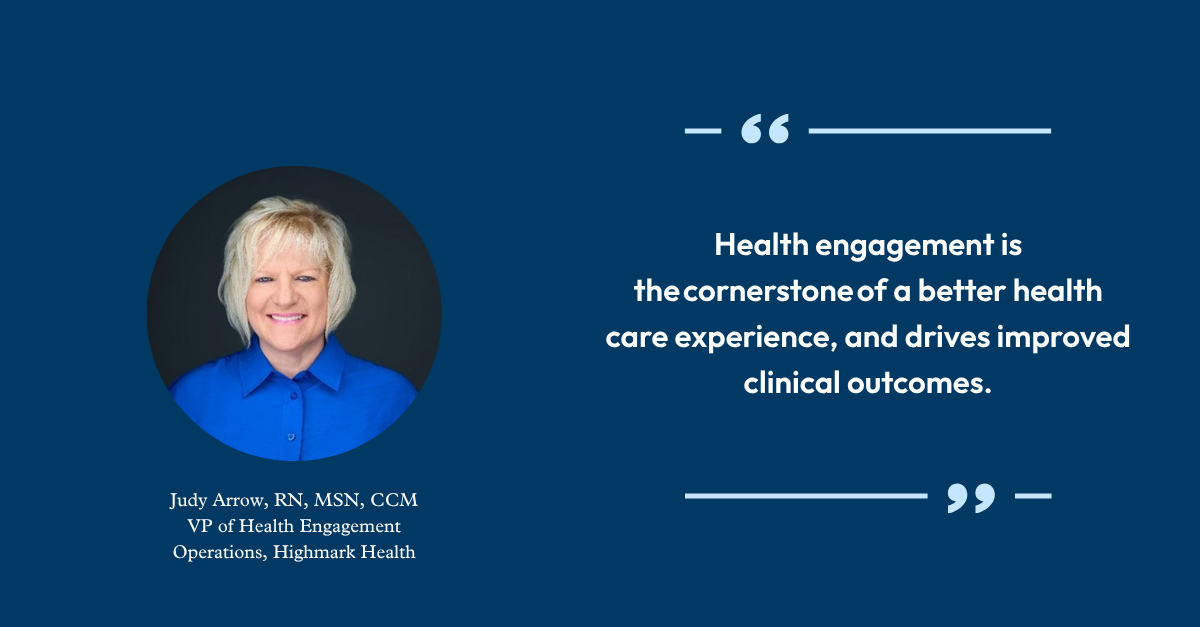
Judy Arrow: Health engagement is the cornerstone of a better health care experience, and drives improved clinical outcomes. By proactively connecting members with the right resources and personalized support, we empower them to actively manage their health. It’s about meeting members where they are, understanding their unique needs, and providing tailored guidance. Technology and data play a crucial role in helping us identify and reach members early, before challenges escalate, to create more opportunities to improve their overall health.
Catherine Clements: How do we measure the impact of health engagement?
Judy Arrow: We gauge the impact of our health engagement efforts through a combination of quantitative and qualitative measures. Key performance indicators include improvements in health outcomes, reduced hospital readmissions and avoidable emergency department visits, increased adherence to medication and preventive screenings, and higher rates of provider follow-up. Most importantly, we listen to our members. Their feedback, captured through satisfaction surveys and direct interactions, provides invaluable insights into their experience and helps us continuously refine our programs.
Catherine Clements: What are the biggest challenges and opportunities in health engagement operations in the current health care landscape?
Judy Arrow: A significant challenge lies in optimizing our case management processes. We're actively working to streamline administrative tasks through automation, freeing up our highly skilled case managers to focus on direct member interaction and complex care coordination. By empowering them to work at the top of their license, we maximize their impact on member outcomes. We are also committed to creating a seamless, omnichannel experience that makes it easier for members to connect with the support they need, when and how they need it. This includes expanding digital access, integrating various clinical specialists into the call queue, and facilitating warm transfers to case managers, ultimately eliminating barriers to engagement and providing on-demand services for our members.
Catherine Clements: Insurers have been doing case management for a while. How has it evolved over time?
Judy Arrow: Case management at Highmark continues its transformation journey. We've evolved from a reactive, manual approach to a proactive, technology-enabled model focused on empowering members. Here’s how:
Catherine Clements: How does Highmark leverage data analytics to inform case management strategies and empower case managers to personalize care coordination?
Judy Arrow: Data analytics provides valuable insights that inform our case management strategies. Case managers start with a comprehensive assessment to understand each member's unique needs, goals, and challenges. The member's own priorities guide the care plan. For example, a member struggling with shortness of breath might express their primary goal as attending their grandson's wedding. In this case, we would focus on supporting behavior changes and providing resources that help them manage their condition, enabling them to achieve their personal goal and improve their overall quality of life.
Catherine Clements: One of the other ways Highmark is also engaging members is through Member Engagement Guides. Tell me more about that.
Judy Arrow: Our Member Engagement Guides (MEGs) serve as trusted health plan navigators, guiding members through the complexities of their health plan and connecting them with the care they need. Initially created in 2017, the MEGs now support a wide range of member populations, including those in our commercial, Medicare Advantage, and Medicaid plans.
Catherine Clements: What makes MEGs different from case managers, and how do they benefit our members?
Judy Arrow: While case managers provide clinical expertise, MEGs offer comprehensive support across a broader range of needs. They act as navigators, helping members understand their benefits, find providers, and make informed decisions about their health. MEGs also play a crucial role in addressing provider disruptions and ensuring members stay connected to care, utilizing scheduling capabilities to expedite appointments and resolve any access issues.
Let me share a couple quotes that we have received from members.
- “[The MEG] was absolutely amazing and so helpful. She was able to answer all of my questions and went above and beyond emailing me all of the information I needed to know. I’m very happy to have a primary doctor now and my daughters have a pediatrician as well.”
- “[The MEG] has been exceptional throughout the turbulence of changes in my prescription plan. She provided clear information in a timely manner and was patient in answering all questions. She is a real asset!”
Catherine Clements: Do you have patient engagement guides too? How do the guides connect with Highmark's team and resources?
Judy Arrow: Our commitment to integrated care extends to our provider partners. Allegheny Health Network (AHN) was so impressed with our MEGs that they developed their own version, Patient Engagement Guides (PEGs). Highmark's MEGs are designed to complement PEGs, ensuring a seamless and integrated experience for members across both payer and provider settings. Both MEGs and PEGs connect members with Highmark's digital solutions, such as our member portal and mobile app, providing convenient access to information, resources, and care management tools. Furthermore, PEGs leverage Epic scheduling to facilitate direct appointment scheduling with PCPs, specialists, and for preventive screenings.
Catherine Clements: How are we or planning to integrate case management with the rest of a person’s health experience?
Judy Arrow: We are actively building the future of integrated case management. Our roadmap includes several key initiatives designed to create a more seamless and personalized health experience for our members. This includes leveraging predictive analytics to identify members who would benefit from early intervention, integrating comprehensive data from across the health care ecosystem, and enhancing data sharing with members and providers. Our vision is to empower members with seamless access to Highmark’s comprehensive clinical and non-clinical support throughout their entire health care journey. By proactively monitoring their progress, we extend a continuous hand — providing timely outreach whenever rising risk or gaps in care arise.
Catherine Clements: What is the most rewarding aspect of your role as VP of health engagement operations?
Judy Arrow: Witnessing the positive impact our work has on our members' lives is incredibly rewarding as well as empowering our teams to provide the best possible support. It's not just about metrics or operational efficiency; it's about equipping our clinical staff with the tools and resources they need to deliver empathetic, personalized care that makes a real difference. It gives me real satisfaction to witness our teams driving improved health outcomes and impacting the lives of members and leave their distinctive influence on a patient's life and that makes it easy to support this fantastic team. Knowing that we're empowering our teams to do their best work, with more empathy and focus, is what fuels my passion to continue this transformational journey.
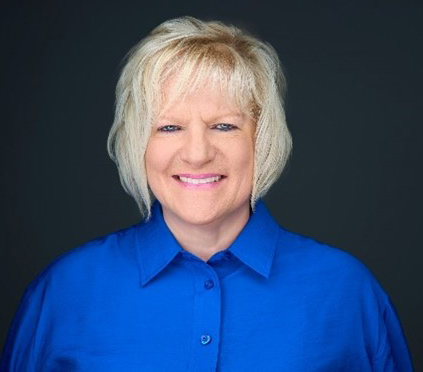 As vice president of health engagement operations at Highmark Health, Judy Arrow, RN, MSN, CCM, oversees a diverse team of licensed clinicians and customer-facing staff. This team is responsible for the management of Highmark's clinical programs and support services, encompassing case and disease management (including specialty), behavioral health, pharmacy, social work, and wellness initiatives. Judy brings over 25 years of management, operational leadership, and clinical experience in both the provider and health plan landscape, with a strong focus on leading teams that deliver case and disease management services for commercial and government programs. Judy is a Registered Nurse with a Master of Science in Nursing from Carlow University, specializing in Case Management and Professional Leadership, and she holds a Certified Case Manager (CCM) certification.



Highmark Health and its subsidiaries and affiliates comprise a national blended health organization that employs more than 42,000 people and serves millions of Americans across the country.
Entire contents © Highmark Health. All Rights Reserved.
Highmark Health is an independent licensee of the Blue Cross Blue Shield Association.
 Need to find info about providers, prescriptions, coverage, claims, ID cards, or health spending or savings accounts? If so, your Highmark member site is the place to go. (It’s separate from this blog.)