

 Share This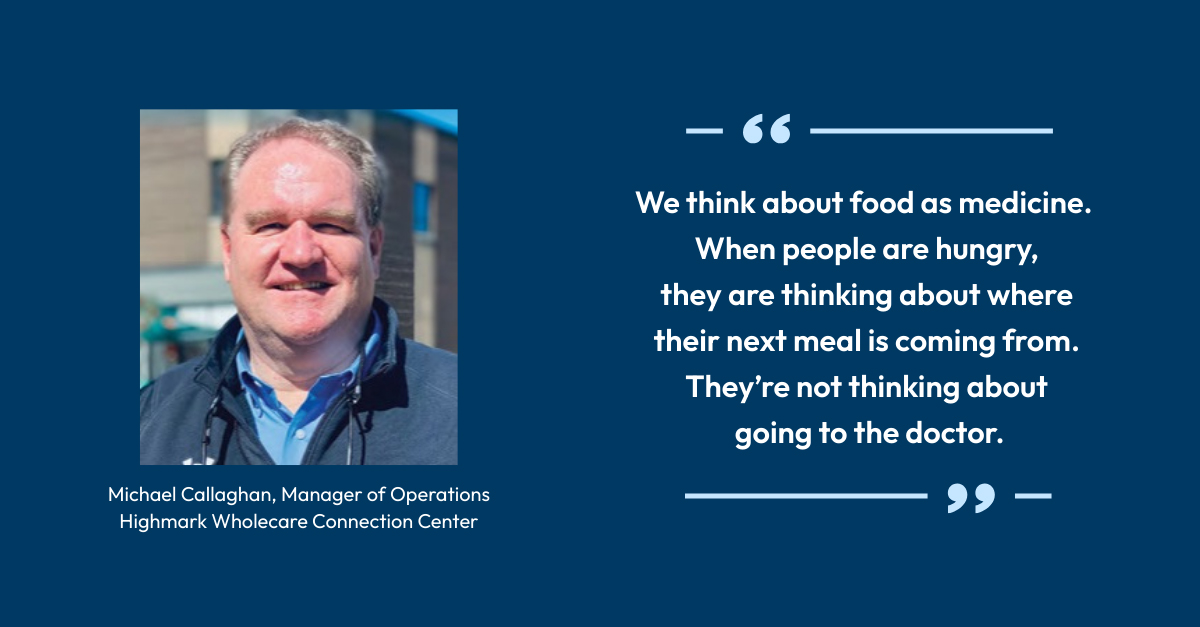
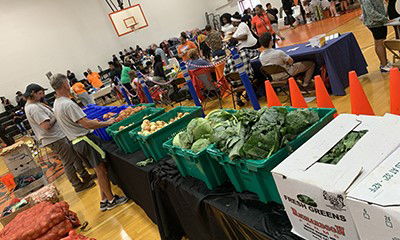
When Michael Callaghan planned an event to distribute free produce for the first time, he was unsure what the turnout would look like. To avoid waste, he brought 3,200 pounds of food and scheduled the event to run from noon to 4 p.m.
It was gone in an hour.
That experience offers a glimpse into the rising levels of food insecurity. One in eight people experiences food insecurity annually, according to Feeding Pennsylvania, a nonprofit association of food banks. What’s more, the organization says, about half the state’s residents live paycheck to paycheck, meaning they are one emergency away from needing to choose between housing, utilities and food.
“It’s amazing how fast a distribution can go,” Callaghan says. “It’s incredible to see that amount of produce. People are so grateful that it can help lighten their grocery bill that month or help them get through another week.”
Callaghan’s work to address food insecurity is part of his role as manager of operations for the Highmark Wholecare Connection Center. Highmark Wholecare serves more than 330,000 Medicaid and Medicare members across Pennsylvania. Its Connection Center offers in-person guidance and programs, such as health care coordination, wellness and nutrition education.
“We think about food as medicine,” Callaghan explains. “When people are hungry, they are thinking about where their next meal is coming from. They’re not thinking about going to the doctor for a flu shot.”
In addition to poor physical health, research has shown that food insecurity is also linked to stress, anxiety and depression, and is a major risk factor for childhood behavioral problems.
In Philadelphia, Highmark Wholecare’s commitment to fighting food insecurity includes senior community engagement specialists who work directly with individuals. For example, Jhaisa Castillo visits senior housing buildings when the region’s hunger relief organization delivers its monthly food boxes. She brings recipes and nutrition information designed around that month’s food selection and helps residents plan healthy, delicious meals. She does this in Spanish as well as English, noting that it is important to teach people about nutrition “in their own language with the food that they mainly cook and eat at home.” She adds that the need for food has increased.
“The line of people has tripled throughout the past year,” she says. “And you see the nervousness about what will happen if they don’t receive it next month.”
Marvetta Coleman, another Highmark Wholecare senior community engagement specialist, says she has seen the same thing on her visits to senior living buildings. She often brings a game called Nutrition Bingo and offers fresh fruits and vegetables as prizes.
“Coming up and getting the produce as a prize used to be a nice extra,” Coleman says. “What I'm seeing now is that for participants playing the games, this has become another extension of their food supply.”
Food insecurity is just one of the social determinants of health that influence well-being and account for as much as 80 to 90% of a person’s health.
Highmark Wholecare was among the first health plans to focus on social determinants, which were often overlooked in traditional health care models.
“We’re building in elements of health that go beyond medicine,” Callaghan points out.
For many Highmark Wholecare members, multiple overlapping social determinants negatively impact their health, including lack of access to quality food, housing, education, employment and transportation. To address those challenges, Highmark Wholecare works closely with a range of local nonprofits and community-based organizations, treating them as critical components of the health care ecosystem.
One such effort is the Farm-to-Family initiative, a growing statewide model that draws together local farmers, food banks, health care providers and schools to break down barriers to health and wellness. Highmark Wholecare piloted the program in 2024, distributing 84,000 pounds of food to 3,500 families while also providing on-site health screenings and Medicaid support services. Callaghan is planning 25 Farm-to-Family markets and expects to distribute more than 120,000 pounds of food to more than 6,000 families throughout 2025.
A key partner of Highmark Wholecare in southeastern Pennsylvania is Share Food Program, a network of community-based organizations and school districts engaged in food distribution, education and advocacy. With support from Highmark Wholecare and others, Share Food Program distributed more than 30 million meals in 2024, including more than 4,500 nutritious food boxes to homebound seniors each month.
The Highmark Wholecare team also supports smaller, grass-roots efforts. The Growing With Highmark initiative allows Coleman and Castillo to distribute supplies so that seniors can grow fresh herbs in their apartments. Other examples across the state include working with a church to clear some of its property and build the infrastructure for a community garden, supporting community gardens and garden boxes in partnership with East End Cooperative Ministry, and inviting Dress for Success to hold quarterly workforce development events at a Connection Center, coinciding with food distribution.
Highmark Wholecare also helps people connect with the resources they need. For example, in Philadelphia it offers programs to assist older adults with using their mobile devices so they can access a database of food pantries and food distribution sites as well as Highmark’s curated social services resources.
“That small step of helping seniors with their technology is a way to expand how they can deal with food insecurity,” Coleman says. “It becomes a gateway to resources.”

Highmark Wholecare’s work addressing food insecurity and other social determinants of health demonstrates how community partnerships and proactive, holistic care can improve individual health and strengthen overall community resilience. The broader goal remains clear: eliminating barriers so that residents live healthier, more secure lives.
Coleman notes that helping one member of a family often improves the outcome of others, with grandparents learning to cook for grandchildren and children participating in food distributions at school to help their families.
“It is looking at it from a multi-generational standpoint,” she says. “If we can figure out ways to impact our younger generation, then perhaps they can grow up in a healthier space and not have to suffer from dynamics such as unhealthy eating or residing in a food desert.”
Healthy communities lead to healthy individuals — and vice versa. The organization wants to build positive momentum on both sides of that relationship.
“It’s not just about our Highmark membership,” Callaghan says. “It’s about the entire community.”
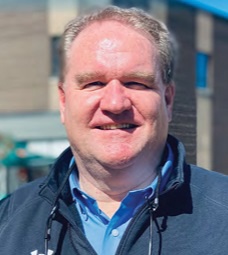 Michael Callaghan is manager of operations for Highmark Wholecare Connection Center, overseeing all aspects of the delivery of health services and community programs, including those addressing social determinants of health. He initiated a new enterprise community program, free Farm-to-Family produce markets, that brings together community organizations, schools, local food banks, and internal teams such as the AHN Center for Inclusion Health's Healthy Food Center.
Early in his career, he spent 12 years with Gateway Health Plan (now Highmark Wholecare) in account executive and community development leadership roles. Subsequently, he served as executive vice president of sales, business & community development for InnerLink, Inc., including securing $17 million in sales revenue. Next, as client relationship manager at RJ Lee Group Laboratories, he reported to the CEO and executive vice president of new business development, producing over $10 million in new revenue in less than three years. Prior to rejoining Gateway Health Plan in 2020, he then served as executive vice president of sales and business development at Population Health Innovations, Inc., a start-up technology company, including managing its sales plan and developing a new market strategy, along with marketing, public affairs, training, and customer service functions.
A U.S. Marine Corps veteran and combat correspondent, Callaghan rose to the rank of sergeant with deployments including Panama (Operation Just Cause), Persian Gulf (Operation Desert Storm), and humanitarian aid in the U.S. after Hurricane Hugo. He holds a bachelor's degree in Mass Communication from Clarion University, as well as diplomas in Public Relations, Journalism, and Radio and Television from the Defense Information School.



Highmark Health and its subsidiaries and affiliates comprise a national blended health organization that employs more than 42,000 people and serves millions of Americans across the country.
Entire contents © Highmark Health. All Rights Reserved.
Highmark Health is an independent licensee of the Blue Cross Blue Shield Association.
 Need to find info about providers, prescriptions, coverage, claims, ID cards, or health spending or savings accounts? If so, your Highmark member site is the place to go. (It’s separate from this blog.)