

 Share This
Nearly one in five birthing parents experience Perinatal Mental Health Disorders (PMHDs), collectively the most common complication of childbirth. To meet the urgent and often overlooked care needs of these parents, Allegheny Health Network (AHN) opened the Alexis Joy D’Achille Center for Perinatal Mental Health at AHN West Penn Hospital in 2018 — one of the nation’s few behavioral health programs designed to support patients from pregnancy through postpartum.
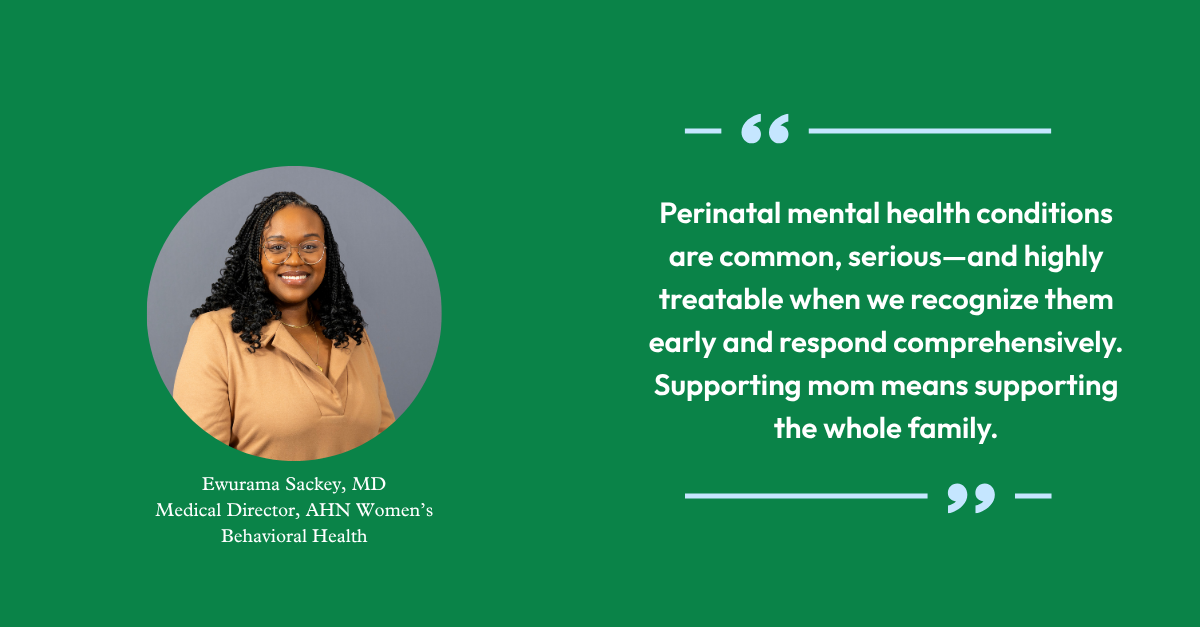
“Too often, we treat maternal mental health as an afterthought,” says Ewurama Sackey, MD, Medical Director of Women’s Behavioral Health at AHN. “But these conditions are common, serious, and highly treatable when we build systems that recognize them early and respond comprehensively.”
Since its launch, the program has drawn national and international attention for elevating maternal mental health as a public health priority — and for helping connect more families to specialized support. “Maternal mental health has made great strides over the last decade,” Dr. Sackey adds, “but progress only matters if it translates into access, understanding, and meaningful support for patients. We are still not reaching the majority of patients with these disorders.”
This video shares the story behind the Alexis Joy D’Achille Center, and the families it supports every day.
Dr. Kirsten Newhams: So, once we know the diagnosis, there are actually a range of options. Classically and what most people will be treated with or proton pump inhibitors or what we call antacids.
Steven D'Achille (President, The Alexis Joy Foundation): I was so angry. Like how much more can you do to try to get help?
Kim Holmberg (Advisory Board Member, The Alexis Joy Foundation): I felt that I was inadequate as a mother.
Lea Fishburn-Moore (Participant, AHN Intensive Outpatient Treatment Program): And I wish that I didn't feel this way.
Steven D'Achille (President, The Alexis Joy Foundation): The struggles that Alexis dealt with after giving birth really started in the delivery room. She was diagnosed with post-traumatic stress disorder from the delivery. You know, with each breastfeeding that didn't go well, like she felt like a worse mom. And we made seven different trips in her last 13 days to different hospitals. The problem was the doctors weren't listening to her. Alexis took her own life, just 6 weeks after giving birth. She spent two and a half days in intensive care before she passed. So unfair. I guess is the word. It was so unfair how she was treated. You don't know what you need until you go to get it and it doesn't exist and it's not there. And so that was really the impetus for the foundation. We're going to build a center that will listen.
Dr. Ewurama Sackey (Medical Director, AHN Women's Behavioral Health): When I'm talking to my patients, I'm learning from them. I'm learning what their needs and their wants and their goals are. I'm learning how to be a better doctor. So, our program is extremely unique. We are basically an outpatient clinic. One of our main foundational programs is our intensive outpatient program.
Lea Fishburn-Moore (Participant, AHN Intensive Outpatient Treatment Program): Six weeks postpartum is when like I really realized that like my usual therapy and psychiatrist wasn't cutting it. I probably needed some more like specialized care and she recommended West Penn and their outpatient program. I'm not from Pittsburgh. My family's not here and so it gave me like this community. Something that was said in group a lot is even if you can't hold hope for yourself, we'll hold hope for you. That's something that I think got me through like a lot.
Dr. Ewurama Sackey (Medical Director, AHN Women's Behavioral Health): Funding from our supporters has meant that we don't have to question which projects we can pursue and which ones we have to maybe hold back on.
Kim Holmberg (Advisory Board Member, The Alexis Joy Foundation): What inspired me to support this program is the fact that I myself suffered from postpartum. We have been so blessed with the support we have received, but the need is so great.
Dr. Anthony Mannarino (System Chair, AHN Psychiatry and Behavioral Health Institute): Unfortunately, people can't access services immediately. So, with greater philanthropic efforts, we're able to expand the programs.
Dr. Ewurama Sackey (Medical Director, AHN Women's Behavioral Health): And also to provide care outside the traditional boundaries of a hospital.
Lea Fishburn-Moore (Participant, AHN Intensive Outpatient Treatment Program): I feel very fortunate that the center exists. And that the people that loved her turned their grief into something so positive.
Adriana D'Achille (Alexis and Steven's Daughter): When I think about what my dad's done, it makes me super proud because it shows like moms are coming there, so instead of struggling on their own, they have somewhere to find help.
Steven D'Achille (President, The Alexis Joy Foundation): I guess it gives purpose to the pain. I don't know why we were dealt this hand, but I feel like the luckiest, most blessed guy in the world to be in the position I'm in.
PMHDs include perinatal depression, anxiety, obsessive-compulsive disorder, post-traumatic stress disorder, and — more rarely — postpartum psychosis. Untreated, these conditions can profoundly affect both mother and infant. Mothers may experience chronic depression, impaired bonding, and increased risk of substance use or suicide, while infants may face emotional, cognitive, and developmental challenges that can persist long beyond infancy.
“When a mother is struggling silently, the impact is rarely isolated,” says Dr. Sackey. “These illnesses affect bonding, family stability, and a child’s long-term development. Supporting the mother is supporting the whole family.”
One of the greatest barriers to care is concern about medication use during pregnancy and lactation. While these fears are understandable, evidence consistently shows that untreated moderate to severe mental illness often poses a far greater risk.
“Untreated depression or anxiety isn’t benign,” Dr. Sackey explains. “It can interfere with prenatal care, increase stress exposure for the fetus, and affect a parent’s ability to care for themselves or their baby.”
Even with increased awareness, stigma and limited access to specialized care still prevent many parents from seeking help.
“Early identification is everything,” Dr. Sackey says. “We can’t help if people don’t feel safe speaking up—or if systems aren’t designed to listen.”
AHN’s Women’s Behavioral Health program delivers mental health care across a woman’s lifespan, with specialized expertise in the perinatal period. By embedding behavioral health services within OB/GYN and primary care settings, the program makes support easier to access and enables earlier intervention.
“We want mental health care to feel like a natural extension of prenatal and postpartum care,” says Dr. Sackey. “Not something separate, not something hidden — but something that belongs in the same space as physical health.”
This collaborative, multidisciplinary model brings together OB/GYNs, primary care providers, therapists, and perinatal psychiatry specialists. Services include universal screening, accurate diagnosis, individualized treatment planning, evidence-based psychotherapies such as cognitive behavioral therapy (CBT) and interpersonal therapy (IPT), and care coordination that ensures continuity and follow-through.
What truly distinguishes the Alexis Joy D’Achille Center is its focus on the mother-baby dyad. Infants attend sessions alongside their mothers, allowing clinicians to observe interactions, support attachment in real time, and strengthen the relationship that is foundational to infant development.
“We’re not treating symptoms in isolation,” Dr. Sackey explains. “We’re treating the relationship. That bond is central to healing for both mother and baby.”
Dyadic therapies help build maternal confidence, support sensitive parenting, and reinforce secure attachment—while also addressing maternal mental health concerns. “When we support that connection early,” Dr. Sackey says, “we’re investing in long-term outcomes for families.”
The Center also prioritizes a welcoming, non-judgmental environment. “Many parents worry they should feel grateful, happy, and be coping perfectly,” Dr. Sackey says. “We make it clear that struggling doesn’t mean failing—it means you deserve care.”
Decisions about psychiatric medication during pregnancy and postpartum are among the most emotionally complex many parents face. “Fear is one of the most common emotions we encounter,” Dr. Sackey notes. “Fear of harming the baby, fear of being judged, fear that medication means they’ve somehow done something wrong.”
Perinatal psychiatry requires a highly specialized approach, grounded in individualized risk-benefit analysis. “Our goal is to create individualized plans for each patient. The question isn’t ‘Is medication risky?’” says Dr. Sackey. “It’s ‘What are the risks of treating versus not treating — and how do we make the safest, most informed choice together?’”
AHN offers preconception counseling and medication management throughout pregnancy, postpartum, and breastfeeding, emphasizing shared decision-making at every stage. “Our role is to listen, share the most current evidence, and partner with patients in decisions that align with their values and needs,” Dr. Sackey adds.
Medication management is integrated with psychotherapy and dyadic care, often enabling faster symptom stabilization and deeper therapeutic engagement. “When a mother starts to feel like herself again,” Dr. Sackey says, “that’s when confidence returns, bonding strengthens, and joy becomes possible.”
Recognizing that perinatal mental health affects entire households, the Center actively includes partners in treatment and offers on-site childcare for older children during sessions.
“Practical barriers are real,” says Dr. Sackey. “If we don’t address childcare, scheduling, and family dynamics, we’re unintentionally excluding people from care.”
For patients needing more intensive support, the Center provides a Perinatal Intensive Outpatient Program (IOP), offering multiple days per week of structured therapy alongside embedded perinatal psychiatric care. “This level of integration allows us to respond quickly and comprehensively,” Dr. Sackey explains. “Patients don’t fall through the cracks.”
This model supports earlier intervention, faster stabilization, stronger engagement in care, and reduced need for hospitalization — while helping families build a healthier foundation.
“When you support a mother’s mental health,” Dr. Sackey says, “you’re supporting her ability to parent, to connect, and to thrive.”
Perinatal mental health care is not one-size-fits-all — it requires expertise, compassion, and care designed around real lives. AHN’s Women’s Behavioral Health program and the Alexis Joy D’Achille Center demonstrate what’s possible when mental health is treated as a core part of perinatal care.
“Supporting maternal mental health isn’t just a clinical responsibility,” Dr. Sackey says. “It’s a societal obligation. And when we get it right, the impact lasts for generations.”
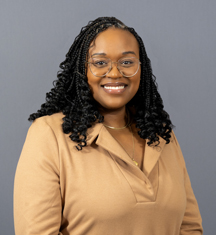 Born and raised in Toronto, Ewurama Sackey, MD, attended the University of Pennsylvania. After teaching high school in New Orleans and St. Louis, she returned to the University of Pennsylvania for medical school and general adult psychiatry residency; she served as chief resident in her fourth year. Dr. Sackey then completed her child and adolescent fellowship program at the University of California Los Angeles (UCLA). Her clinical interests include reproductive psychiatry, perinatal, psychiatry, maternal-infant mental health, and child & adolescent psychiatry.
She has received numerous awards including the APA/SAMHSA Fellowship Award, American Psychoanalytic Association Fellowship Award, UPenn Department of Psychiatry Outstanding Senior Resident Award, UCLA Child and Adolescent Psychiatry Greenblatt Award, and the Association of Women Psychiatrists Alexandra Symonds Fellowship Award.
Dr. Sackey is a certified facilitator for the Circle of Security Parenting Program. She has completed courses in psychotherapy, psychopharmacology and perinatal loss with Postpartum Support International.


Highmark Health and its subsidiaries and affiliates comprise a national blended health organization that employs more than 42,000 people and serves millions of Americans across the country.
Entire contents © Highmark Health. All Rights Reserved.
Highmark Health is an independent licensee of the Blue Cross Blue Shield Association.

 Need to find info about providers, prescriptions, coverage, claims, ID cards, or health spending or savings accounts? If so, your Highmark member site is the place to go. (It’s separate from this blog.)