

 Share This
At some organizations, proposed environmental initiatives are treated as if they are detached from other parts of the business. But Allegheny Health Network (AHN) is making strides in integrating sustainability into its core operations, proving that exceptional patient care and environmental stewardship go hand in hand.
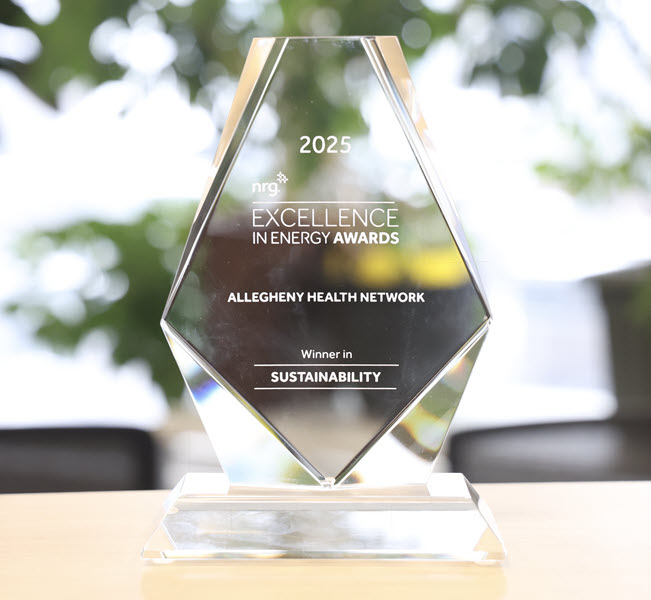
This commitment recently earned AHN the prestigious NRG Excellence in Energy Award for Sustainability, a particularly significant honor since AHN was the only health care provider nationwide to be awarded in this year’s program.

The concept of sustainability within a complex health care system might seem abstract. At AHN, it’s a philosophy that manifests in tangible, practical ways. According to Daniel Lesinski, energy and sustainability manager, it includes holistically integrating environmental responsibility with financial viability and enhanced community well-being. He adds that the approach is fueled by collaboration across all levels of the organization and unwavering leadership support.
Studies indicate that the U.S. health care sector is responsible for about 8.5% of the nation’s total carbon emissions. This footprint stems directly from facility operations and indirectly from energy procurement and the extensive supply chain for health care goods and services.
To actively address this challenge, AHN established its Sustainability Steering Committee in July of 2024, bringing together a diverse team of clinicians and staff from various departments to identify and champion green initiatives. Together, they have already identified more than 50 projects projected to reduce emissions by over 20,000 tons annually.
While the vision was clear, bringing these plans to fruition presented hurdles. Lesinski notes that, like many health systems, a couple major barriers included lack of capital funding and the complexity of implementing strategies across a network of more than 23,700 team members.
“Operating as a nonprofit, we don’t necessarily have the funds to cover every initiative we’d like to put in place,” says Lesinski. “A key part of the success we’ve had involved crafting net-positive business cases for leadership that showcase the impact on our operational budget, proving that these ideas will reduce cost while also reducing emissions.”
This strategic approach proves that sustainability initiatives contribute to broader organizational objectives like operational efficiency, patient satisfaction, and community health. Demonstrating this multifaceted value has helped to garner essential buy-in from both leadership and team members, uniting everyone around a shared mission.
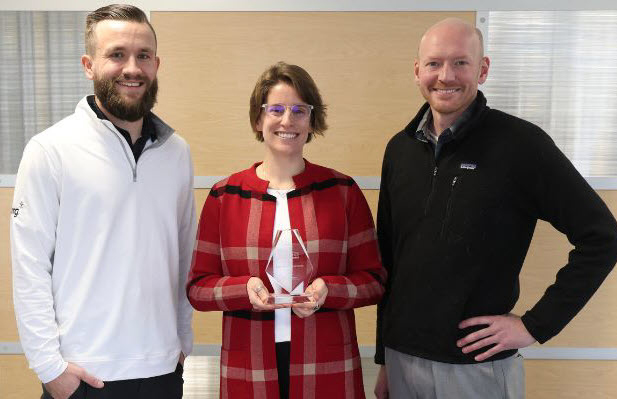
The formation of AHN’s Sustainability Steering Committee emerged from an organic, grassroots movement.
“It wasn’t a top-down directive,” says Lesinski. “Multiple stakeholders from across the organization came together through internal networking, realizing our collective potential for collaboration. I don’t have visibility into every part of our operations, so when a team member like a nurse identifies an opportunity to be more sustainable in their area, it’s incredibly valuable.”
Lesinski says he and the committee are always excited to learn about new ideas and partner with those individuals to bring their ideas to fruition.
This collaborative spirit led to partnerships with leaders across multiple areas, including perioperative care, anesthesiology, and environmental services. The committee quickly realized the potential for shared best practices, expanding successful initiatives from one facility across the entire network. A prime example is a "greening the OR” initiative, led by Ann Miller-Burke, DNP, vice president of perioperative services, and Lindsay Turner, MD, urogynecologist and medical director of supply chain, both co-chairs of the Sustainability Steering Committee. This initiative served as a catalyst for the broader committee’s formation and focuses on reducing waste and improving environmental practices within operating rooms (OR), an area often characterized by high resource consumption.
Among other accomplishments, “greening the OR” has meant achieving a smoke-free surgical environment at four of AHN’s hospitals. Surgical smoke is a hazardous byproduct of any surgical procedure, produced when heat is applied to tissue. According to one study, the average daily impact of surgical smoke produced in an operating room is equivalent to smoke produced from 27-30 cigarettes.
“We are working ahead of the curve here in Pennsylvania,” says Miller-Burke. “We are proud that AHN Allegheny Valley, Canonsburg Hospital, Jefferson Hospital and Saint Vincent Hospital have been recognized by the Association of Perioperative Registered Nurses as Centers of Excellence in Surgical Safety for Smoke Evacuation, committing to the health and safety of our patients and staff.”
Miller-Burke says that AHN is working toward becoming smoke-free across the network.
Furthering these efforts, Dr. Turner highlights another innovative approach. “We are placing green bins in every operating room to collect used disposable instruments, including scissors and laparoscopic ports. We then partner with Stryker, a medical technology company, to reprocess and resell these items, diverting waste from landfills.”
Dr. Turner explains that AHN hits all aspects of the classic “reduce, reuse, and recycle” hierarchy, from meticulously analyzing supply chain to reduce waste at its source, to creatively finding new homes for products to be reused, to implementing programs to recycle as much as possible.
AHN has over 50 sustainability projects either completed or underway. Here are a few notable examples:
AHN's success is also attributed to its robust network of external partnerships. Collaborations with organizations like Sustainable Pittsburgh and the Green Building Alliance provide invaluable networking opportunities, benchmarking insights, and access to expertise. These partnerships facilitate the sharing of best practices with counterparts at other institutions, fostering a collective advancement of sustainability in western Pennsylvania.
Beyond industry peers, AHN also partners with community-focused organizations like Tree Pittsburgh and Gaia Scape to design, plan and maintain community gardens, aligning with a commitment to holistic community health.
The journey toward a more sustainable health care system is ongoing, and AHN's approach offers valuable lessons. As Lesinski advises, “Don’t underestimate the power of people on the front lines and the wisdom within your organization’s departments. By asking ‘how can you be more sustainable in your space?’ and then providing the support and resources to act on those ideas, you build a culture where sustainability becomes everyone’s responsibility and a natural extension of care.”
By strategically integrating diverse perspectives — encompassing financial savings, emissions reductions and improved patient satisfaction scores — organizations can construct a strong business case for sustainability, embedding environmental responsibility into their operational fabric.
“Don’t take no for an answer,” says Dr. Turner. “There’s always a solution, always an innovator, and always a partner out there who shares a forward-thinking vision. It’s about persistently seeking out those individuals or organizations who see the potential, just as we do, to transform challenges into sustainable opportunities.”
 Dan Lesinski brings a decade of expertise in energy and sustainability, including four years of dedicated services at AHN. He holds an MS in Sustainability from the University of Leeds and a BS in Industrial Design. Outside of work, Dan is passionate about conservation and enjoys spending time in nature with his family and three dogs.
 Dr. Lindsay Turner specializes in female pelvic medicine and reconstructive surgery.
Dr. Turner earned her medical degree from Loyola University. She completed her obstetrics and gynecology residency at Magee-Women’s Hospital of UPMC in Pittsburgh, where she was chief resident. She continued at Magee-Women’s Hospital to complete a fellowship in female pelvic medicine and reconstructive surgery. During her fellowship, she completed a master’s degree in clinical research.
She is a member of the American College of Obstetricians and Gynecologists and the American Urogynecologic Society. She is well-published in various medical journals, including the International Urogynecology Journal and the American Journal of Obstetrics and Gynecology.
 Ann Miller-Burke, DNP serves as the vice president of Perioperative Services for Allegheny Health Network, where she oversees surgical operations for eight network hospitals. Before her role at AHN, Dr. Miller-Burke served as director of Surgical Services at UPMC Shadyside. Additionally, she has many years of patient safety, quality, and nursing experience.
Dr. Miller-Burke earned her Doctor of Nursing Practice (DNP) from Carlow University; a Master of Science in Nursing Administration and a Bachelor of Science in Health Policy and Administration from Penn State University; and a Bachelor of Science in Nursing from Duke University. She is a Certified Professional in Patient Safety and a board member for the Pittsburgh chapter of the Association for Perioperative Services.



Highmark Health and its subsidiaries and affiliates comprise a national blended health organization that employs more than 42,000 people and serves millions of Americans across the country.
Entire contents © Highmark Health. All Rights Reserved.
Highmark Health is an independent licensee of the Blue Cross Blue Shield Association.

 Need to find info about providers, prescriptions, coverage, claims, ID cards, or health spending or savings accounts? If so, your Highmark member site is the place to go. (It’s separate from this blog.)