

 Share This
“Our Living Health model is fundamentally about population health. That means finding ways to help people live their best lives without having health interfere with that,” says Bruce Meyer, M.D., MBA, OB-GYN and executive vice president, chief population health Officer at Highmark Health. “It’s about whole-person health, including physical, mental and social health. We’re not just managing the disease, we’re taking care of the person who has the disease at the individual, human level.”
In this interview, Dr. Meyer overviews the enterprise population health strategy designed to improve health outcomes, enable better experiences and reduce the total cost of care.
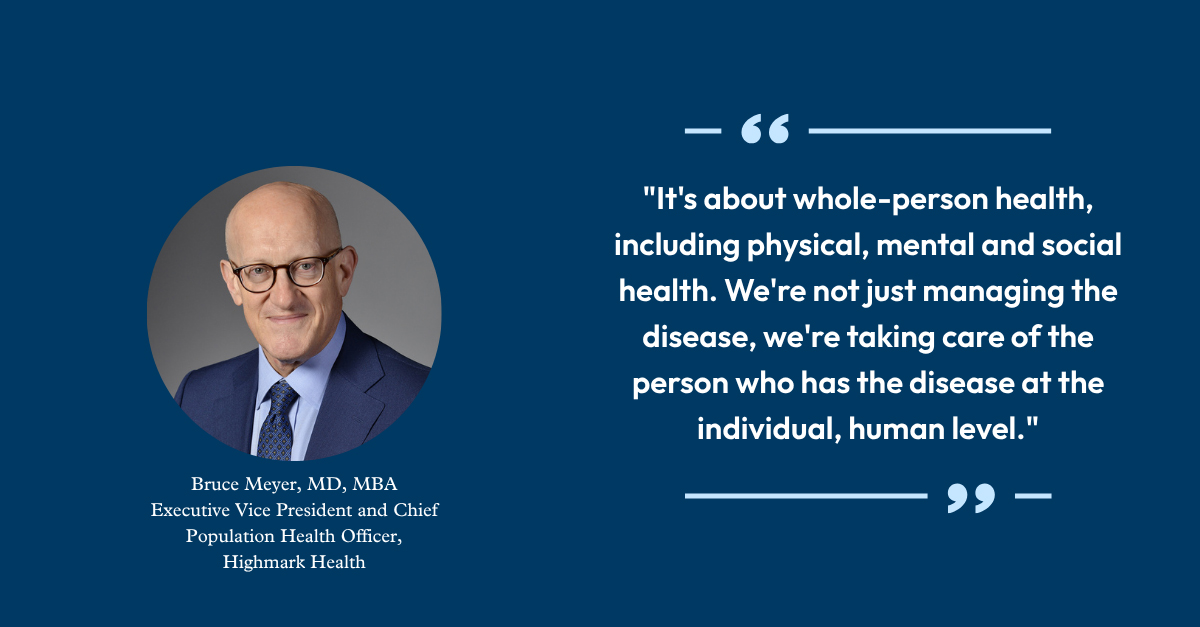
Catherine Clements: Let’s start with more about your role. What are you focused on as the chief population health officer?
Dr. Bruce Meyer: As the chief population health officer, I’m focused on working with my team to create systems of care that serve the largest number of people in the most effective and efficient way. It's about ensuring people get to the right provider at the right time and receive optimal care the first time they need it, without unnecessary care or unnecessary variation in that care. That helps take waste out of the system where redundant actions or extra steps aren’t contributing to a better health outcome. This extends to managing acute conditions and diagnoses effectively.
Then the next focus area is prevention. How do we try to prevent you from having a diagnosis in the first place? This approach aims to prevent the need for emergency room visits, hospitalizations, or specialist procedures that could be better managed earlier in a patient’s care journey.
Much of this preventive work involves screening, including cancer screenings (breast, colon, cervical, prostate) and other initiatives like fracture prevention. For instance, knowing that hip fractures can significantly impact longevity, the focus is on early interventions like diagnosing osteoporosis, ensuring adequate calcium and magnesium intake, and promoting weight-bearing exercises to maintain bone and muscle mass. This is the core of preventive health care.
While I hold the title of chief population health officer, there are thousands of individuals across Highmark Health who are focused on this kind of work every day. Many of these initiatives, such as our value-based reimbursement program, contracting strategies, palliative care, case management, and digital solutions, are fundamentally population health initiatives aimed at improving the lives and outcomes of the people we serve, even if they aren't explicitly labeled as such.
Furthermore, marketing plays a crucial role in activation and engagement. Programs like Mental Well-Being Powered by Spring Health or advanced multi-chronic care management are only effective if members engage with them. These teams are doing vital population health work by helping members recognize the value of engaging with these programs that can significantly improve their lives and outcomes.
Catherine Clements: Beyond medical diagnoses and traditional preventive care, how does Highmark Health's population health strategy address the broader social determinants of health and the everyday life circumstances that impact an individual's well-being?
Dr. Bruce Meyer: True population health is about how we prevent you from winding up in an emergency room due to preventable conditions like a stroke or heart attack, or how we manage conditions like high blood pressure when life circumstances complicate traditional medical approaches.
We recognize that simply having you come to my office two or three times a year to measure blood pressure and hand you a prescription isn't effective if you've just lost your job and can't pay rent. While we can't solve job loss or rent issues directly, we can try to understand how these social factors affect your health and mitigate their potentially costly and devastating effects. One of the ways we’re doing that is through our Social Health Center of Excellence, and connecting individuals directly to resources through our Community Support Platform and Social Care Network. For example, if you can’t get to a doctor, can we figure out transportation. Or if you’re not able to afford prescriptions, can we find ways to help you get them.
Communication and health literacy is another area of opportunity. We must consider how to communicate effectively so individuals can understand their treatment plan and actively participate. We know that 25% of prescriptions don't get filled, and 20-30% of those filled aren't taken properly. We’re thinking about how we help with that – whether through reminders, notifications, etc.
We don't always think of this as part of care provided, but population health is about meeting you where you are in your life and finding ways to keep you healthy. And if you do get sick, it's about ensuring you receive the most effective care to get you back to your healthy life.
Catherine Clements: What specific population health initiatives are you excited about and are making a difference for the people we serve?
Dr. Bruce Meyer: Highmark Health is engaged in numerous population health programs. Some of the impactful initiatives I am particularly excited about include:
Catherine Clements: How is Highmark Health's approach differentiated from other integrated or value-based care models in the market?
Dr. Bruce Meyer: The biggest differentiator for us is that our value-based programs and approach are not entirely primary care focused. While primary care plays an important role, we believe specialists also have very important roles in cost-effective and efficient care. Specialists account for a good portion of health care spending. If we don't involve them, we miss the opportunity to manage total care costs effectively.
Furthermore, with our open networks, many members directly access specialists without a primary care referral. This makes it essential for us to engage these specialists — such as cardiologists, orthopedic surgeons, rheumatologists, and gastroenterologists — in leveraging best practices, managing the total cost of care, and considering the whole person beyond their specific subspecialty.
Catherine Clements: Looking three to five years ahead, what are the most significant opportunities and challenges for population health across the industry?
Dr. Bruce Meyer: Two main areas stand out when considering the future of population health. First, there's a significant opportunity and challenge in improving preventive care, and crucially, ensuring this work extends beyond primary care to include specialists like we discussed. Prevention is rapidly becoming an even more critical component of our efforts, as it's the most effective way to avert long-term adverse health outcomes and mitigate escalating health care spending.
Second is addressing the unsustainable cost of care. Health care expenditures in the U.S. are projected to reach 20% of the total economy by 2030, a burden increasingly shifted onto individuals through co-pays, deductibles, and co-insurance. This financial strain contributes significantly to health care debt, which is a major cause of personal bankruptcy.
Consequently, we must discover more cost-effective strategies to prevent this burden from falling disproportionately on individuals. When care becomes unaffordable, people forgo essential services like filling prescriptions, seeing doctors, or addressing minor issues. These deferred actions can escalate into serious and expensive problems, such as advanced cancer diagnoses, later on. Therefore, a key focus for us must be on early diagnosis and the deployment of effective, less expensive treatments to prevent these more costly and devastating later-stage conditions.
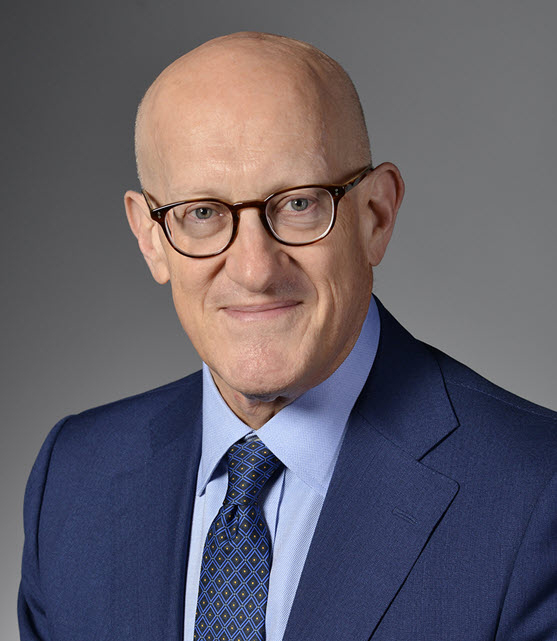 Bruce A. Meyer, MD, MBA, is chief population health officer of Highmark Health, a $32.4 billion national, blended health organization that includes one of America’s largest Blue Cross Blue Shield insurers and a growing regional hospital and physician network. Based in Pittsburgh, Pa., Highmark Health’s 47,000 employees serve millions of customers nationwide through the nonprofit organization’s affiliated businesses, including Highmark Inc., Allegheny Health Network, HM Insurance Group, United Concordia Dental and enGen.
Dr. Meyer leads the design and implementation of solutions that deliver clinically appropriate and high-quality care while ensuring affordability and access. This includes leading the development and evaluation of programs, and shaping health plan designs to drive cost-effective care.
Previously, Dr. Meyer was executive vice president and Western PA and West Virginia Market president for Highmark Health. In this role, Dr. Meyer oversaw Highmark Health's blended payer-provider strategy in the western Pennsylvania market, including the operations of Highmark's western Pennsylvania insurance division as well as its western Pennsylvania-based provider system, Allegheny Health Network. In the West Virginia market, Dr. Meyer was responsible for all market functions including health, dental, vision and stop-loss products and services.
Dr. Meyer joined Highmark Health in 2022 after serving as President of Jefferson Health in Philadelphia and Senior executive vice president of Thomas Jefferson University. He is also a Professor of Obstetrics and Gynecology and Population Health at Jefferson's Sidney Kimmel Medical College.
At Jefferson, Dr. Meyer oversaw the health system's multitude of clinical services offered across the greater southwestern Philadelphia region, footprint that includes 18 hospitals and more than 100 outpatient and urgent care centers. Home to the renowned Sidney Kimmel Cancer Center, and one of the largest faculty-based telehealth networks in the country, Jefferson employs approximately 42,000 people, including nearly 2,500 physicians and 9,600 nurses.
Prior to his role as President of Jefferson Health, Dr. Meyer was executive vice president for Health System Affairs, Executive Director of the Faculty Practice Plan and Professor of Obstetrics and Gynecology at UT Southwestern (UTSW) Medical Center in Dallas, Texas. The author of over 70 peer-reviewed publications, Dr. Meyer has won multiple teaching awards while serving as a residency and fellowship program director and academic chair.
Dr. Meyer earned his medical degree at the University of Texas, where he also completed an OB-GYN residency and maternal-fetal medicine fellowship. He received his MBA from the University of Tennessee.



Highmark Health and its subsidiaries and affiliates comprise a national blended health organization that employs more than 42,000 people and serves millions of Americans across the country.
Entire contents © Highmark Health. All Rights Reserved.
Highmark Health is an independent licensee of the Blue Cross Blue Shield Association.

 Need to find info about providers, prescriptions, coverage, claims, ID cards, or health spending or savings accounts? If so, your Highmark member site is the place to go. (It’s separate from this blog.)