

 Share This
In our Ask a Doc series, we sit down with physicians and other clinical experts, including those at Allegheny Health Network (AHN), for a chat on an important health topic. In this interview, we discuss suicide prevention with Doug Henry, PhD, a clinical psychologist and vice president and medical director of Enterprise Behavioral Health at Highmark Health.
Most people know someone who has struggled with their mental health. Yet many of us still hesitate when it comes to talking openly about suicide.
We worry we'll say the wrong thing. We fear we'll make matters worse. Sometimes, we convince ourselves that someone else's pain isn't ours to ask about.
According to Doug Henry, PhD, clinical psychologist, and vice president and medical director of Enterprise Behavioral Health at Highmark Health, those fears often prevent the very conversations that can save lives.
As part of Suicide Prevention Awareness Month, we sat down with Dr. Henry to discuss the misconceptions surrounding suicide, warning signs that friends and family members should know, and how proactive behavioral health support can help people get the care they need before a crisis occurs.
Maddie Goerl: Suicide is something many people still struggle to talk about. Why do we need to have these conversations?
Dr. Doug Henry: The reason that we need to talk about it is that we lose a lot of people to suicide because no one has asked them how they are doing, or if they're having thoughts of hurting themselves or ending their lives.
It's taboo because, particularly in Western cultures, much of our behavior is motivated by a denial of death or a fear of death. We don't talk about it. We lock it away in a corner of our minds.
But the truth is, when you ask someone who's depressed or upset if they're having thoughts of suicide, people respond very well. People feel seen.
When people are struggling and you ask that question, they're often relieved because they realize someone understands the seriousness of what they're dealing with. It establishes a closeness in the relationship that can be quite healing.
The challenge isn't the other person's reaction. The challenge is our own reluctance.
Maddie Goerl: If you're worried about someone, what's the best way to start the conversation?
Dr. Doug Henry: You don't have to have the perfect words. Something as simple as "How's it going?" can be an effective way to open the door. The important thing is to be genuinely curious and willing to listen.
If you're still concerned after talking, don't stop there. Ask directly: “Are you having thoughts of hurting yourself?”
People often want a more comfortable way to phrase it, but clear and direct language is best. Asking the question doesn't create risk. It creates an opportunity for an honest conversation.
Maddie Goerl: We’ve made progress reducing stigma around mental health, but many people are also living in a more socially disconnected world. How does that affect mental health and suicide risk?
Dr. Doug Henry: Relationships are what give life meaning and purpose.
What concerns me is that we're seeing increasing social isolation at a time when people need connection more than ever.
I'm not someone who thinks technology is all bad, but there are aspects of modern life that make it easier for people to become isolated. And when people are isolated, they're disconnected from the relationships that protect us during difficult times.
Many individuals spend less time engaged in meaningful relationships and more time disconnected from one another.
Suicide prevention isn't only about responding to a crisis. It's also about building strong relationships before a crisis ever occurs.
When people feel connected to their families, friends, faith communities, colleagues and healthcare providers, they're more likely to seek help when they need it. Connection creates resilience. Isolation can deepen emotional pain.
Maddie Goerl: How can family members, friends and coworkers recognize when someone may be struggling?
Dr. Doug Henry: One of the most important things to pay attention to is change, especially when that change involves withdrawing from social relationships.
When someone begins withdrawing from relationships, avoiding conversations, or isolating themselves from activities they once enjoyed, those changes can be meaningful warning signs.
There are also some specific behaviors that deserve attention:
One of the more important warning signs is also one of the most misunderstood. If someone has been severely depressed and suddenly seems unusually relieved or upbeat for no obvious reason, that can be cause for concern. Sometimes loved ones interpret that as a sign that things are getting better. In certain situations, it may indicate that a person has made a decision about ending their life and feels relief as a result.
That's why it's important to stay engaged and ask questions when something feels different or unusual.
Maddie Goerl: What role does proactive screening play in suicide prevention?
Dr. Doug Henry: It's one of the most effective tools we have. Our organization takes a proactive approach to identifying people who may need support. We use behavioral health screenings such as the PHQ-9 to help identify depression and suicidal ideation early. When concerns are identified, more specialized tools like the Columbia-Suicide Severity Rating Scale can help behavioral health experts determine the appropriate level of care.
The goal is to identify people experiencing suicidal ideations before a crisis escalates and connect them with the right resources as early as possible.
Built-in screenings are also part of Mental Well-Being Powered by Spring Health, a digital solution offered to Highmark health plan members. Individuals complete simple online screenings that help identify depression, anxiety and suicidal ideation, so people can be connected to support before their situation becomes more severe. We’ve measured and reported significant clinical outcomes from Mental Well-Being screenings — and those screenings have helped care teams connect at-risk members with care before their needs became more urgent.
Maddie Goerl: Parents often struggle to tell the difference between typical teenage behavior and a more serious mental health concern. What should they know?
Dr. Doug Henry: Some separation is a normal part of development. Teenagers naturally seek independence and may want more privacy than they did as children. What parents shouldn't assume is that independence means a teenager no longer wants a relationship.
I often tell parents to keep moving toward their teens, even when they're being pushed away. Continue checking in. Continue showing interest. Continue creating opportunities for connection.
Outwardly, teens may seem to want space. But many still need reassurance that the important adults in their lives are present and available.
We're also seeing concerning trends among young girls. A recent JAMA Pediatrics study has shown that suicide rates among girls ages 10 to 14 have more than quadrupled. Social isolation, social comparison and online pressures are all factors worth paying attention to.
That makes it even more important to help young people build healthy relationships and learn how to talk openly about their emotions.
Maddie Goerl: At what point should someone seek professional intervention?
Dr. Doug Henry: If someone is expressing thoughts of suicide, has developed a plan, feels like a burden to others or has shown warning signs that suggest they may be at immediate risk, professional help should be involved right away.
Maddie Goerl: Where should someone turn if they're worried about themselves or a loved one?
Dr. Doug Henry: There are resources available at every level of need.
For immediate support, the 988 Suicide & Crisis Lifeline provides free, confidential assistance 24 hours a day, seven days a week.
As mentioned, Highmark health plan members and Highmark Health employees also have access to resources through Mental Well-Being Powered by Spring Health, including 24/7 crisis support services.
In the state of Pennsylvania, county-based mobile crisis response teams can be dispatched to assess individuals in crisis and help connect them with the appropriate level of care.
Beyond crisis intervention, programs such as Mental Health First Aid, Talk Saves Lives and the AHN Chill Project help build mental health awareness and resilience long before an emergency occurs.
Maddie Goerl: If someone reading this is struggling with their mental health, what would you want them to know?
Doug Henry: I would want them to know that they are not alone.
Reach out to someone you trust. Talk to a friend, family member, counselor, physician, religious counselor or crisis team. Reach out to someone.
Moments of crisis can make people feel like there is no way forward, but there is.
We don't strive to lower suicide rates. We strive for the absence of suicide.
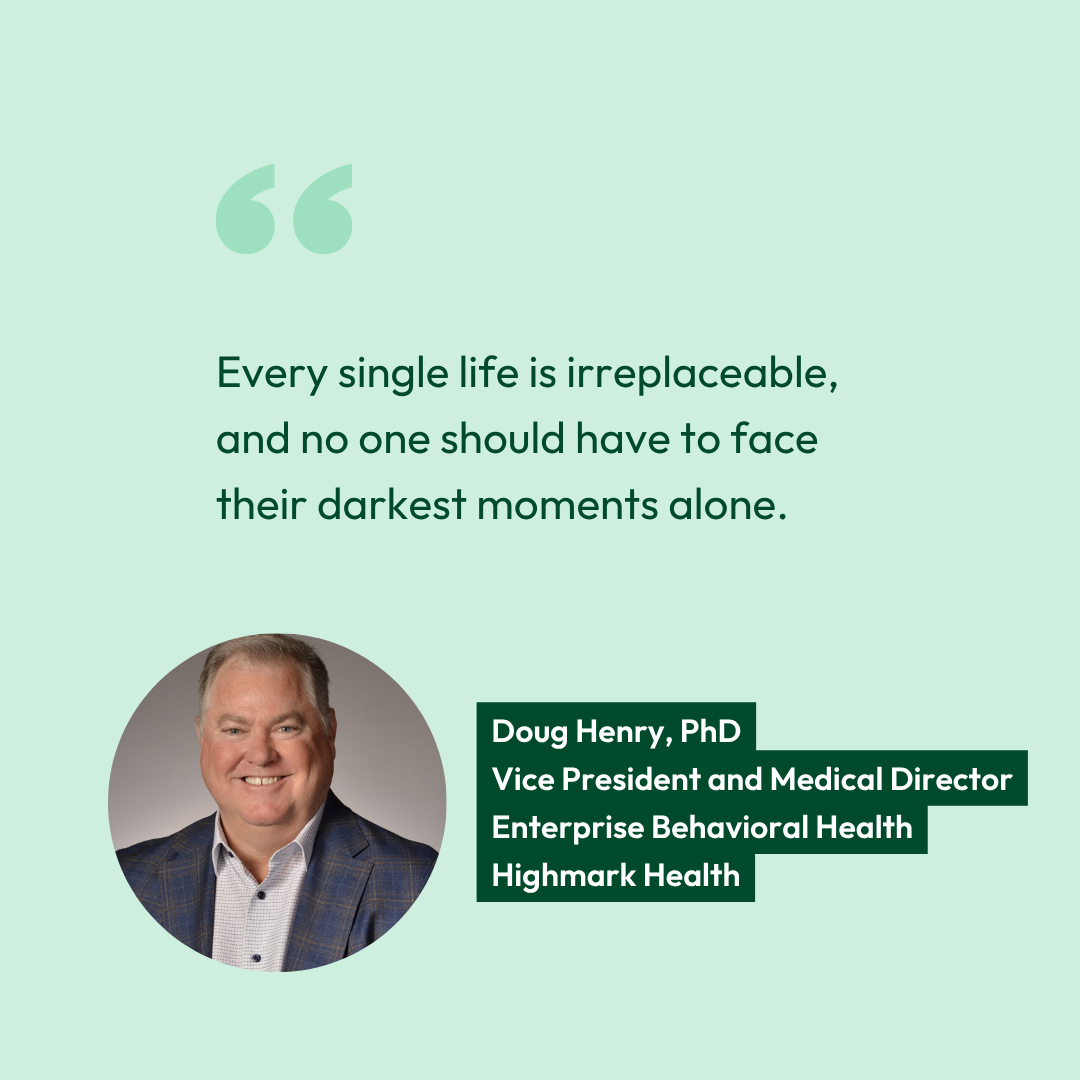
Every single life is irreplaceable, and no one should have to face their darkest moments alone.
 Doug Henry, PhD, is vice president and medical director of Enterprise Behavioral Health at Highmark Health, a $32 billion national, blended health organization that includes one of America’s largest Blue Cross Blue Shield insurers and a growing regional hospital and physician network. Based in Pittsburgh, Pa., Highmark Health’s 47,000 employees serve millions of customers nationwide through the nonprofit organization’s affiliated businesses, including Highmark Inc., Allegheny Health Network, HM Insurance Group, United Concordia Dental and enGen.
In his current role, Dr. Henry leads the development and implementation of a comprehensive enterprise mental behavioral health strategy focused on improving access, reducing stigma, and improving overall quality of mental behavioral health care. He is committed to addressing the full spectrum of mental health needs, from early intervention and prevention to specialized care for complex conditions.
Dr. Henry is a clinical psychologist licensed in Pennsylvania and California and brings over 20 years of experience in professional applied psychology including inpatient, outpatient, and administrative assignments.
Attracted by the integrated payer-provider model, and emphasis on patient-centered treatment, Dr. Henry initially joined the enterprise as a vice president for AHN Psychiatry and Behavioral Health Institute in 2017.
Prior to joining AHN, Dr. Henry served as clinical administrator at Western Psychiatric Institute and Clinic for UPMC Child and Adolescent Behavioral Health Services, the UPMC Center for Autism and Developmental Disorders, and the UPMC Center for Eating Disorders.
Dr. Henry’s interests focus on providing broader access to the highest quality services for adults and families coping with mental illness and/or developmental challenges.


Highmark Health and its subsidiaries and affiliates comprise a national blended health organization that employs more than 42,000 people and serves millions of Americans across the country.
Entire contents © Highmark Health. All Rights Reserved.
Highmark Health is an independent licensee of the Blue Cross Blue Shield Association.

 Need to find info about providers, prescriptions, coverage, claims, ID cards, or health spending or savings accounts? If so, your Highmark member site is the place to go. (It’s separate from this blog.)