

 Share This
This article is the first in a series focused on the critical role community health workers (CHWs) play in the U.S. health ecosystem, their unique ability to build trust and connect people to resources and care, and some of the ways our organization integrates CHWs to improve health equity and outcomes.
Kevin Moore is a health care worker. But he does not wear scrubs, or work in a sterile building with industrial lighting.
When I talked to him, he had spent part of his day on a park bench helping a mother apply for social services like SNAP, while her child laughed and played on the playground.
Kevin is a community health worker (CHW) with ChristianaCare in Delaware, and he is assigned to help that child and dozens of others with mental and behavioral health challenges. But before he can get that child into clinical programs, he needs to build trust with the entire family and understand the challenges of everyday life that make it harder for them to get care.

Kevin knew this mother needed social assistance, but he also knew she didn’t want to sacrifice what little free time she had between multiple jobs to drag her child around to various office buildings. His efforts meant that she didn’t have to make that choice. He went to her, met the family where they were, physically and metaphorically, to get them help and build trust to take the next step in their health journey.
Kevin is an extraordinary individual, but the role of CHW is increasingly seen as something that should become standard for the U.S. health ecosystem. As of 2022, the U.S. had nearly 70,000 community health workers across a variety of settings, and that number is expected to grow by 14% by 2032.
The U.S. health industry and media often focus on the power of technological innovation to transform how we identify and treat illness, how we track, monitor, and analyze results, and how we can engage and empower consumers to own and improve their health.
However, there must be a foundation of trust before anyone will engage with an organization or its innovative technology, or even its clinicians and health care professionals. This series highlights the ultimate trust builders: community health workers. This article introduces the role CHWs already play in the U.S. health system, with expert insights on how they can improve health outcomes, particularly in underserved communities. We’ll also look at some of the challenges to maximizing the impact of CHWs at scale.
Across nearly a dozen interviews for this series, every single person shared one core message: building trust is the CHW’s superpower. No matter how far we go with technological evolution, real, genuine human connection remains the best way to earn trust.
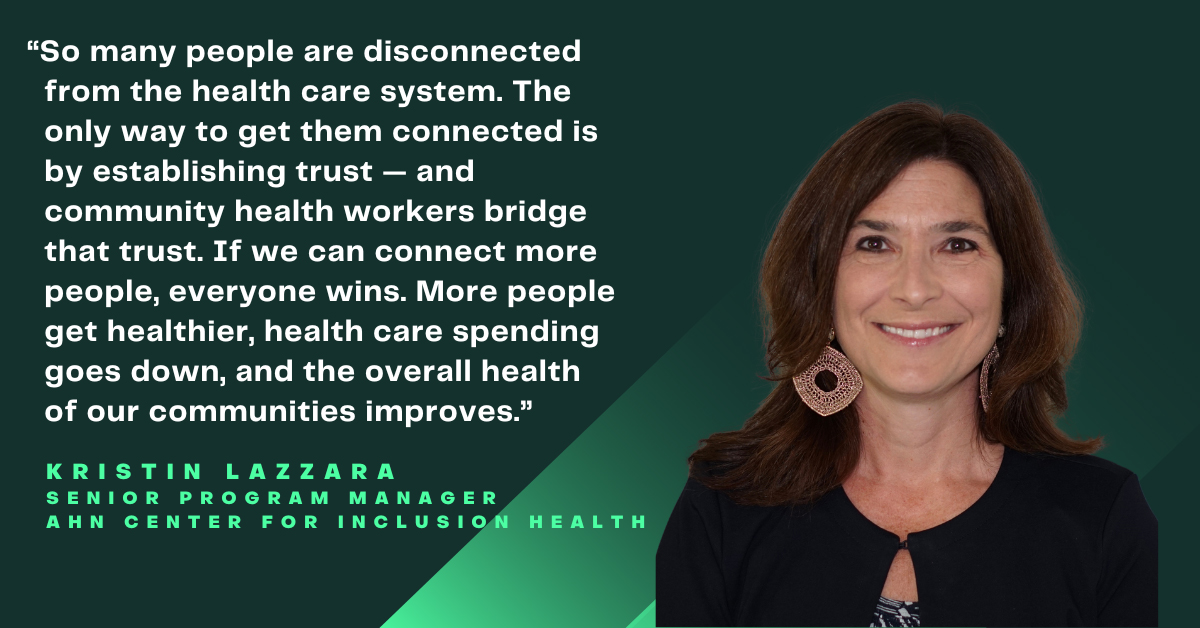
“So many people are disconnected from the health care system,” explains Kristin Lazzara, senior program manager with the AHN Center for Inclusion Health, which employs CHWs across multiple programs. “The only way to get them connected is by establishing trust — and community health workers bridge that trust. If we can connect more people, everyone wins. More people get healthier, health care spending goes down, and the overall health of our communities improves.”
That trust is often built on a foundation of shared life experiences and shared community — in a real sense, that’s what makes someone a “community health worker.” That may mean living in the same neighborhood, but it also includes having battled similar challenges like income insecurity or addiction and recovery, having similar racial or ethnic backgrounds, speaking the same language, needing to manage the same chronic condition, and other experiences that define a community.
Ellen Duffield, president and chief executive officer of Highmark Wholecare, also emphasizes the critical connection between trust and being part of a person’s community, especially for Highmark Wholecare’s Medicaid populations.
“There's a level of trust that a traditional care manager or clinician won't necessarily have right off the bat, but a community health worker is familiar with where and how our Medicaid members are living, and what resources are in their community,” she says. “They can have a much more enriched engagement with someone because of that knowledge.”
Dr. Amit Kale, vice president, Social Determinants of Health at Highmark Health, implemented a statewide CHW-driven initiative in a previous leadership role at a Blue Cross Blue Shield plan. He notes that there is a long history of community health workers in the U.S., and the concept dates back decades. He contrasts the direction of much of modern medicine with one of the core skills of CHWs — listening and empathizing to then motivate.
“When it comes to your health, you want someone who will first and foremost listen to you empathetically, is able to relate, and then is able to guide you,” he says. “If you look at how physicians are trained, the focus is on how to diagnose and treat patients, but we do not get much training on the empathy skill set.”
That underscores the connective role CHWs can play within a larger health ecosystem. Because they are skilled in establishing that foundation of trust, CHWs can help individuals engage more deeply in their health journey, including reconnecting them with traditional clinicians and care support.
Community health workers can be particularly effective in helping to break down barriers to care for individuals from minoritized and underserved communities, many of whom have multiple chronic conditions and intersecting social needs.
As Dr. Kale explains, “when individuals have multiple social needs, which is often the case with those who have financial constraints, such as the Medicaid population, engaging them is a necessary first step to start improving their health.”
Despite the accelerating adoption of digital health solutions, engaging traditionally underserved and hard-to-reach members often requires a more grassroots approach, or what Duffield calls “feet in the street.”
“There’s always going to be a need for personal interaction in health care,” she says. “And when we’re dealing with the communities we serve through Medicaid, that becomes much more important because of all the different challenges those community members encounter on a day-to-day basis.”
For example, CHWs can help remove social and cultural barriers, such as transportation, food insecurity, language, health literacy, and other social determinants of health. Removing those barriers clears a path for someone to begin engaging in activities that can improve health. At that point, Duffield adds, CHWs are in a great position to “work directly with people to drive engagement and close care gaps, whether that’s helping someone manage health conditions, ensuring communication with their care manager, or getting them to their physician’s office.”
A growing body of evidence indicates that CHW-driven engagement is a cost-effective way to serve complex patient and member populations. A study of the IMPaCT model found that for every dollar invested in CHWs serving the Medicaid population, there was a $2.47 return on investment. Several studies have found that using community health workers results in better management of chronic conditions, access to preventive care, and patience experience.
Here is another important way that CHW-driven programs help support health equity: Building a CHW workforce creates employment in economically disadvantaged neighborhoods, since a core principle of CHW success is hiring workers of and from the communities they serve.
Given the interconnected cost and labor challenges impacting the entire health sector, the expansion of CHW models holds great promise. However, structural barriers, particularly reimbursement, as well as workforce development and training challenges, must be addressed.
Reimbursement
The clearest way to incentivize and drive adoption of anything in health care is to pay for it. But it was only in January 2024 that Medicare started to pay for CHW activities related to social determinants of health assessments, community health integration services, and principal illness navigation. In Medicaid, which CHW services are reimbursed under what circumstances varies widely by state.
In addition to her leadership role at AHN’s Center for Inclusion Health, Lazzara serves as vice president of the PA CHW Collaborative, where she organizes around investment in community health workers and has looked at the issue of reimbursement extensively.
“CHWs are part of a non-traditional health care delivery system and they present an enormous opportunity to transform how Medicaid reimburses organizations,” she says. “It's a pivotal time in managed care, in Medicaid, in health care delivery — if Medicaid, Medicare and eventually commercial payers get on board with recognizing community health workers as providers, their services would be reimbursed just like any other service. CHWs are vital members of the care team, and may also be employed by community-based organizations that provide non-clinical services. They connect individuals to the clinical and non-clinical services essential to improving overall health.”
Lazzara adds that community health workers especially make sense as the industry turns toward value-based care like the shared-risk model used by AHN and Highmark. Dr. Kale notes that deploying a large-scale CHW model gets complicated in the traditional fee-for-service model due to conflicting financial incentives.
“If your end goal is better health outcomes, improved patient and clinician experience, and reduction in cost of care, community health workers can be incredibly valuable,” he explains. “Health plan and health systems working together in an integrated approach using a value-based model is an ideal way to stand up such an operating model that can be scaled across multiple geographies.”
Recruitment and retainment
In addition to financial challenges, there are workforce development considerations that are critical to building a strong bench of CHWs. All three leaders agree that the essential element — shared experience — can also bring challenges to recruiting and retaining CHWs.
For example, the AHN Center for Inclusion Health has CHWs dedicated to its programs for substance use recovery, street medicine, transgender health, post-incarceration transition, and more.
“We had to recruit in different ways for each of those positions,” Lazzara says.
Additionally, many individuals who are best qualified for CHW roles because of their background and experiences may have a hard time navigating corporate HR processes.
“Not having a paper application, requiring an online application — that is a barrier to many people,” Lazzara says. “Background checks, required references, expectations around what to wear — there can be a lot of potential barriers for people who are otherwise well qualified to be CHWs.”
Duffield reinforces the point that tailoring recruitment to a given need and community will be more successful than relying on one-size-fits-all corporate approaches.
“Recruiting community health workers is a challenge,” she says. “We have seen various models, and we've talked to potential partners who have developed recruitment programs, and what works is a very grassroots approach to finding the best candidates for a specific community.”
Moving beyond hiring and recruitment, as with any other role, there also needs to be adequate training and a clear path for advancement. Without that, retention becomes a challenge.
“To truly have a successful, sustainable CHW model that impacts engagement and behavior change, you not only need to hire the right CHWs, you also need to make sure they have a career path in your organization,” Dr. Kale explains. “One of the biggest challenges you often see is high CHW turnover.”
Seeing the potential value of CHWs is a critical first step. But, especially for large organizations, that’s just the start of a journey that also requires overcoming financial and workforce challenges and effectively integrating CHWs into holistic care models. Success relies heavily on key decisions about where and how CHWs are deployed and ongoing commitment to making the model work.
As Dr. Kale puts it: “Execution is 90% of why a CHW model will succeed or fail.”
In future articles of this series, we will dive into how different parts of the Highmark Health organization already work with CHWs to improve health for various populations.
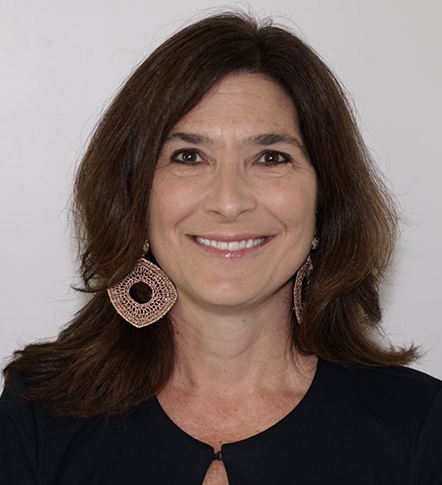 Kristin Lazarra is Senior Manager of Community Engagement and Expansion at the AHN Center for Inclusion Health. She has worked directly with community health workers (CHWs) since 2020 when AHN hired its first CHW for its Urban Health Outreach program, focusing on individuals experiencing homelessness.
Lazzara is also vice present for the PA CHW Collaborative and serves on its Sustainabililty and Legislative Committees. She helped establish the Western PA CHW Community of Practice, which later evolved into the PA CHW Collaborative.
Prior to working at AHN, Lazzara spent 10 years at Pitt Public Health’s Department of Health Policy & Management and the Clinical and Translational Science Institute. She was recently appointed to the Intimate Partner Violence Reform Task Force and the IPV and Health Systems Subcommittee for Allegheny County.
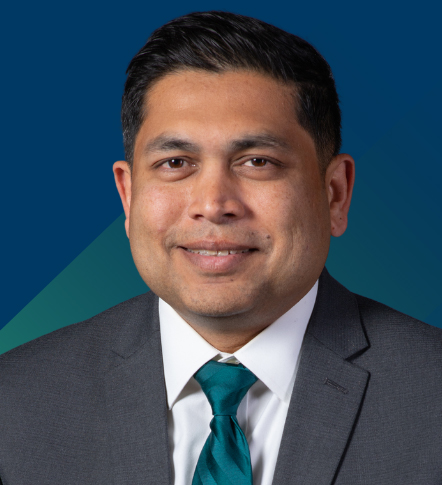 Dr. Amit Kale is a physician leader with extensive experience in health care payer, provider, and technology companies. He is currently vice president, Social Determinants of Health, at Highmark Health.
Prior to coming to Highmark Health, Dr. Kale was director of Healthcare Transformation at Horizon Blue Cross Blue Shield of New Jersey. He was responsible for designing and executing innovative clinical transformation and community health care programs with Horizon’s health system partners. As architect of Horizon’s statewide Social Determinants of Health program, he implemented a unique payer/provider collaborative model utilizing Community Health Workers and Personal Health Assistants.
Dr. Kale’s past roles include seven years in management consulting and health care startups in the payer, provider, and financial services industry. Dr. Kale received his medical degree from University of Mumbai and his MHA from Cornell University.
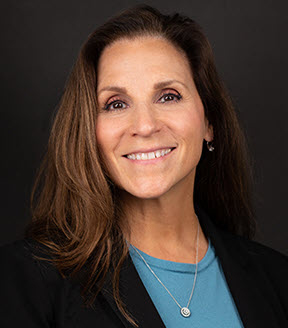 Ellen Duffield is the president and chief executive officer of Highmark Wholecare. As president and CEO, Ellen provides both operational oversight and strategic direction for one of Pennsylvania’s leading managed care organizations. Highmark Wholecare is a community-based, mission-driven organization that serves more than 330,000 members through its high-quality Medicaid and Medicare health plans focused on delivering whole person care.
In addition to her chief leadership role at Highmark Wholecare, Duffield is senior vice president, Medicaid Segment, at Highmark Health, a $27.1 billion, national blended health organization that includes one of the largest health insurers in the nation and a growing regional hospital and physician network. Within the Medicaid Segment, Ellen leads Active Markets, a multistate operation charged with strengthening Highmark’s Medicaid business within its current footprint and positioning the organization for growth.
Prior to being named president and CEO of Highmark Wholecare in 2021, Duffield served as Highmark Wholecare’s senior vice president and chief operations officer. In this role, she led an enterprise-wide technology transformation to help Highmark Wholecare scale up for growth. She also directed Highmark Wholecare’s COVID-19 incident response team and was a key figure in the planning and execution of the company’s support for Pennsylvania’s vaccine rollout.
Duffield first joined Highmark Wholecare in 2019, bringing with her more than 30 years of strategic planning and implementation experience from a wide variety of operational roles in health plan and technology solutions. She previously served as president at DST Health Solutions. Other past roles include senior leadership positions at Visiant Health Solutions, OptumRx, UnitedHealth Group and Anthem.
An advocate for community service, Duffield volunteers regularly with Habitat for Humanity and other frontline nonprofits in the communities Highmark Wholecare serves. She earned her MBA from Penn State and received her bachelor’s degree from Temple University.



Highmark Health and its subsidiaries and affiliates comprise a national blended health organization that employs more than 42,000 people and serves millions of Americans across the country.
Entire contents © Highmark Health. All Rights Reserved.
Highmark Health is an independent licensee of the Blue Cross Blue Shield Association.

 Need to find info about providers, prescriptions, coverage, claims, ID cards, or health spending or savings accounts? If so, your Highmark member site is the place to go. (It’s separate from this blog.)