

 Share This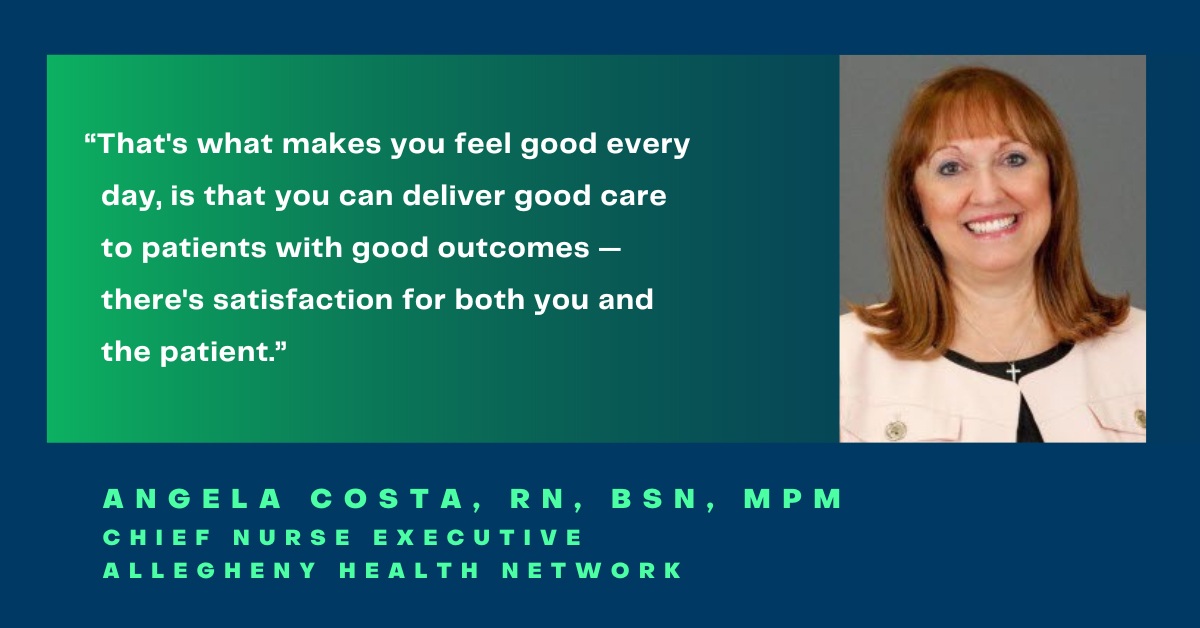
Some people are born to be nurses — but at first, Angela Costa didn’t think she was one of them.
“When I was about 16, my sister had a boss who was in an intensive care unit at Saint Francis Hospital. She said, ‘We need to go see my boss. Will you come with me?’ And I'm like, ‘Sure, why not?’”
Her sense of curiosity was soon overcome by the sense that she’d made a grave error in judgment. “We went into the ICU, and probably within five minutes I was sitting in a chair with two nurses on either side of me,” she says. “It was just so overwhelming, and I thought I would never do this profession.”
And yet, a few years later, she was volunteering as a paramedic. Fast forward a couple decades, and now Costa, RN, BSN, MPM, is chief nurse executive for Pittsburgh-based Allegheny Health Network. As AHN’s top nurse leader, she is the voice of AHN’s 6,000 nurses to the rest of the executive leadership team.
In the following video and Q&A interviews, Costa discusses the state of the nursing profession, what AHN is doing to recruit and retain talented nurses, and AHN’s digital nursing program.
Bill Toland: You didn’t love the idea of being a nurse early on. What drew you in?
Angela Costa: The biggest thing is taking care of patients, wanting to be there for patients — they're at such a vulnerable time in their life, and they just need help, understanding, empathy and caring. And I was just attracted to that.
Bill Toland: Was it difficult to leave the bedside to move into nursing leadership?
Angela Costa: No, because I always stay in touch with the bedside. The luxury of this role is that I oversee all the hospitals in the network — every hospital has a different culture, different people. Every day, I engage, I learn. I don't do bedside work, but yet I can hear from the bedside nurses about what's happening out there, and the issues that need to be addressed.
Bill Toland: Nursing is a much different profession today, compared to when you started. What is AHN doing to recruit new nurses and retain more seasoned ones?
Angela Costa: We have about 45 affiliations with colleges and universities, and they are our front line in attracting students. We have over 1,200 nursing students that do clinical rotations through our hospitals. In addition, AHN has two schools of nursing, West Penn and Citizens — we have a full-time courseload, and we just started a part-time course recently that's been received very well. We recruit about 85% of those students; they come into our network and take positions with us.
Bill Toland: And the more seasoned nurses?
Angela Costa: We’re constantly recruiting experienced nurses. We knew that later-career nurses wanted more flexibility, so about two years ago, we started an internal staffing team. Over 200 nurses were recruited for those roles — they come to our network, they transfer around to 10 different AHN hospitals, doing 6-to-12-week rotations on different units.
Bill Toland: And what are we doing to address caregiver burnout?
Angela Costa: We do a burnout survey every year. And one thing we found was that nurses aren’t always hydrated. They don't get to go to lunch. So one thing we did is that we made sure that every nurse has a lunch break every day. If we assign the lunch break, it takes the pressure off the nurse having to ask another nurse to cover their patients while they eat. Because a lot of times nurses don't want their work to be put on someone else. When we assign their lunch break and we tell them, “You're going to lunch at this time,” we see a lot less missed lunches.
Looking at work-life balance, we launched the “Work Your Way” programs. We offered steady night shift and steady weekend shifts with different incentives for nurses if they work that way.
Bill Toland: Allegheny General Hospital recently achieved a Magnet designation. Why is that so important for AHN and for our flagship hospital?
Angela Costa: Magnet is the gold standard for hospitals when it comes to their nursing workforce. What it says is that in these Magnet hospitals, the nurses are highly trained, engaged in their practice, work at the top of their license, and are involved in hospital operations.
Bill Toland: And when nurses are working at the top of their licenses, that means they feel like they are making a bigger impact on their organization and their patients’ lives, correct?
Angela Costa: I think nurses make the greatest difference and feel great about themselves when they see positive outcomes with their patients and their patients are satisfied. That's what makes you feel good every day, is that you can deliver good care to patients with good outcomes — there's satisfaction for both you and the patient.
Bill Toland: How do you envision the practice of nursing changing over the next 5 to 10 years?
Angela Costa: I think you're going to see a lot more nursing being done remotely.
We will always have a nurse at the bedside. That is one thing we will never lose. But I think some of the work that the bedside nurse does can be done by another nurse far away from the bedside.
Bill Toland: What are the biggest changes you’ve witnessed over the course of your career?
Angela Costa: So much has changed at the bedside — the technology, the way we deliver the care. The people have changed. But what has stayed the same is that we have caring, empathetic nurses at the bedside who want to make a difference in patients’ lives every day.
It is a profession where you will be able to touch another person's life. And you can't say that about a lot of professions. You really get to spend time with patients that are at the happiest and at the lowest points in their lives. You will witness the birth of a baby. You will hold hands of patients as they close their eyes for the last time on this earth. It is such a rewarding profession to be a nurse.
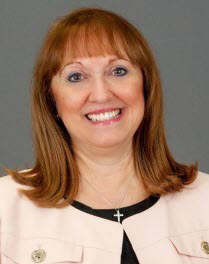 Angela Costa (RN, BSN, MPM) is chief nurse executive for AHN. Costa began her nursing career at Allegheny General Hospital over 30 years ago and has served as chief nurse executive for AHN since 2023.
As CNE, Costa works with the chief nursing officers at each of AHN’s affiliated hospitals to innovate and improve the quality of nursing practice across the organization as well as provide exceptional care to patients and their families. She serves as the voice of the organization’s 6,000 nurses as a member of AHN’s executive leadership team and has led the implementation of best practices in nursing that has made AHN a preferred destination for nursing professionals.
Costa has helped to implement and expand several nursing workforce programs meant to recruit and retain nurses and create new roles and schedules that meet nurses’ personal and professional expectations. Those programs, part of AHN’s “Work Your Way” lifestyle initiative, include the creation of a mobile internal nursing team that allows nurses to float between different AHN hospitals; the creation of new “night owl” and “weekend warrior” shifts that allow nurses to build work schedules that are a better fit with their personal needs; and the creation of a new digital nursing team, which allows nurses to perform certain nursing duties remotely, from their own homes.
Throughout her career with AHN, Costa has served in roles of increasing responsibility, including most recently as the chief nursing officer of AHN West Penn Hospital, vice president of Clinical Nursing Operations, and CNO/COO of Canonsburg Hospital. At West Penn, Costa also led the nursing team’s successful Magnet journey, helping the hospital become Southwest Pennsylvania’s only four-time Magnet-recognized facility — which is the industry’s gold standard for nursing quality.
Costa’s areas of clinical expertise include trauma, critical care, and neurology/stroke. She received her Bachelor of Science in Nursing degree from Duquesne University and later received a Master of Public Policy and Management degree from Carnegie Mellon University.
She serves on the Allegheny Credit Union board and is a member of the Hospital and Health System Association of Pennsylvania’s Nurse Ambassador Advocacy Initiative. Costa also is active in the American Organization for Nursing Leadership (AONL) and Partner for Work, and she is a member of Palladium’s board of directors.
What she’s reading: “The best thing I read recently was Matthew Kelly's The Rocking Chair Prophet. It’s a book that talks about the importance of living and living well, of having good intentions in life. It talks about finding a purpose and having passion in life.”
When she’s not at work, you can find her: “Shopping at Macy’s or dining out at Narcisi Winery and Restaurant.”



Highmark Health and its subsidiaries and affiliates comprise a national blended health organization that employs more than 42,000 people and serves millions of Americans across the country.
Entire contents © Highmark Health. All Rights Reserved.
Highmark Health is an independent licensee of the Blue Cross Blue Shield Association.
 Need to find info about providers, prescriptions, coverage, claims, ID cards, or health spending or savings accounts? If so, your Highmark member site is the place to go. (It’s separate from this blog.)