

 Share This
Our mission is to create a remarkable health experience, freeing people to be their best. In our Remarkable Leadership series, we talk with people who lead the work necessary to deliver on that mission.
Timothy Law, DO, chief medical officer at Highmark and a rural family medicine physician, has spent his career bridging different corners of the healthcare system. Whether shaping medical policies for the country's third-largest Blue Cross Blue Shield plan, making house calls in rural Kentucky, or teaching the next generation of business leaders, he has remained focused on a simple principle: Healthcare works best when it puts people first.
In this Remarkable Leadership conversation, Dr. Law shares his journey to healthcare and his perspective on what it takes to lead with both wisdom and compassion.
Emily Mashore: Your path to healthcare leadership hasn’t been traditional. Tell us more about that path and how it’s shaped the way you lead today.
Dr. Timothy Law: I started in veterinary medicine because I loved science and problem-solving, but eventually I wanted to work more directly with people. From there, I served in the military, completed my medical training, and practiced pediatrics and family medicine. I also taught students and residents and eventually moved into healthcare leadership. Every one of those experiences gave me a different perspective.
One of the reasons I originally went into pediatrics was because it felt familiar. I figured a dog doesn't talk to you and tell you what's wrong, and a young kid may be similar in that way. You learn how to observe, listen, and pay attention to what isn't being said. Later, I realized I wanted to care for entire families.
What I've learned is that every stage of your career should teach you something different. If you're not growing, you're probably standing still.
Emily Mashore: Physician burnout is a challenge across the country. How do you manage that personally and with your teams?
Dr. Timothy Law: I have a different perspective on burnout. There was a study years ago that suggested people need to reinvent themselves about every seven years, and I think there's some truth to that. Burnout often comes from the feeling of stagnation. The same things that frustrate you today may have excited you seven or fourteen years ago. The difference is that you've stopped growing.
One of the great things about medicine is that there are countless ways to contribute. You can practice clinically, teach, do research, or move into leadership. I think too many people become comfortable once they finally feel competent in their role, and then they stay where they are without stepping outside of their comfort zone and eventually feel burnt out. I believe growth is one of the best antidotes to burnout.
Emily Mashore: How has social media changed the physician-patient relationship?
Dr. Timothy Law: Patients aren't just hearing from their doctor anymore. They're hearing from social media, friends, and family, and then putting all of that together to make decisions. Doctors sometimes forget that our first job is to teach, not to dictate. Our responsibility is to give patients information and help them make informed decisions. The challenge today is that people are flooded with information, and a lot of it isn't always accurate.
Emily Mashore: So how do you build trust when patients come in with information they've found elsewhere?
Dr. Timothy Law: The biggest mistake you can make is immediately dismissing what a patient is telling you. I had a patient whose blood pressure suddenly became dangerously low, and we couldn't figure out why. Eventually, his wife explained he was taking grape seed and olive leaf extracts. Those supplements can lower blood pressure. Once we knew what was happening, we adjusted his medications and solved the problem.
That's why I always tell patients to tell me everything they're taking. If patients think you're going to dismiss their concerns, they won't tell you what's actually going on. They're still going to take those supplements; they just won't tell their doctor. Trust starts with being willing to listen.
Emily Mashore: How do healthcare costs affect clinical decision-making?
Dr. Timothy Law: You hope that it doesn't, but you can't ignore reality. Patients have financial constraints, family responsibilities, and different levels of access to care. Good medicine isn't just about ordering every test available. It's about determining which tests are necessary to answer the question you're trying to solve. I tell students that medicine is a lot like putting together a puzzle. You don't always need every single piece before you can see the picture.
Emily Mashore: In your previous video interview, we talked more in depth about rural healthcare. Does practicing rural medicine change your perspective on affordability?
Dr. Timothy Law: Absolutely. For my patients, it's every day, all day. In rural communities, cost isn't just about the test itself. It might mean taking a day off work or driving over an hour to a specialist. Those realities become part of the clinical decision-making process, because healthcare doesn't happen in a vacuum, it happens in people's lives.
Emily Mashore: What role do you see artificial intelligence (AI) playing in healthcare?
Dr. Timothy Law: One of the biggest opportunities is reducing administrative work. Physicians spend tremendous amounts of time dealing with prior authorizations, paperwork, and other tasks that don't directly involve patient care. That’s a lot of tasks to handle while also trying to get the best care for the patient. Technology can help us navigate those processes more efficiently.
Emily Mashore: What gives you hope for healthcare's future?
Dr. Timothy Law: It's the moments where you make a difference. Whether it’s helping a resident understand that it’s OK to show emotion after a patient passes or working with a family through a tragedy, those experiences give you the juice to say, “this is worth it.”
It’s also simple things. I once saw a child screaming in the emergency department waiting area. He couldn’t move his elbow. I recognized it as a common dislocation, popped it back into place there in the waiting room, and he immediately asked his parents, "Can we go now?" In those small but critical moments, you get to take action that makes things better.
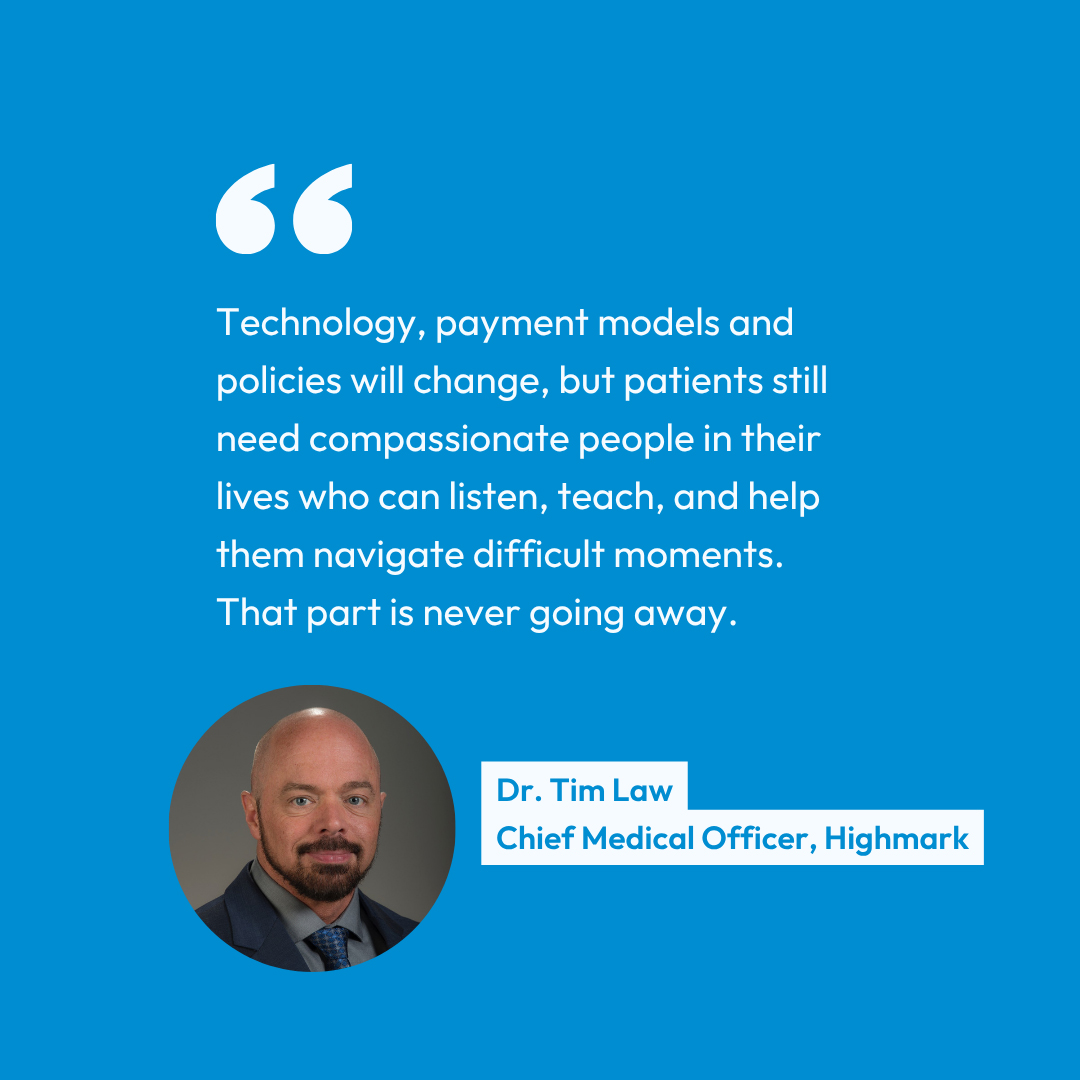
Technology, payment models and policies will change, but patients still need compassionate people in their lives who can listen, teach, and help them navigate difficult moments. That part is never going away.
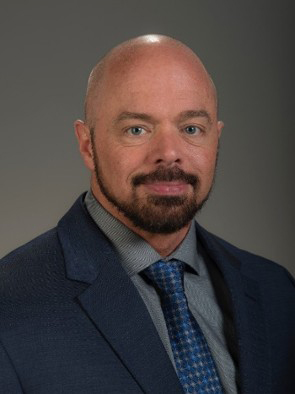 Timothy Law, DO is chief medical officer and senior vice president of integrative care delivery at Highmark.
In this role, Dr. Law leads enterprise efforts to transform utilization management and advance Living Health through strategic collaboration across population health, clinical quality, and value-based reimbursement initiatives, including the True Performance strategy. His portfolio also includes oversight of prior authorization optimization, gold carding programs, the federal employee program, and enterprise clinical integration initiatives.
He began his tenure at Highmark on the medical policy team, where he advanced evidence-based coverage policies to expand access to emerging technologies for members and strategic partners. He now oversees the medical policy function within clinical services and serves as chair of the care management and quality committee.
Dr. Law was the virtual health lead on Highmark’s COVID-19 command center team and led the group in the organization of adding over 1000 codes for inclusion in the coverage policy during the pandemic, helping to bring virtual care to patients.
A board-certified physician with two decades of clinical experience, Dr. Law serves as the medical director and principle investigator of the Ohio Musculoskeletal and Neurological Institute (OMNI) at Ohio University with millions of dollars in NIH grant funded research in healthy aging and wellness.
In addition to his executive leadership responsibilities, Dr. Law maintains active clinical practice as a rural family medicine physician in Kentucky. He leverages virtual care and house calls to deliver comprehensive care, including obstetrics and minor orthopedic and dermatologic procedures.
Dr. Law earned his Doctor of Osteopathic Medicine from the Ohio University Heritage College of Osteopathic Medicine and an MBA in health care management from Indiana Wesleyan University. He completed his family medicine residency at Ireland Army Community Hospital in Fort Knox, Kentucky.


Highmark Health and its subsidiaries and affiliates comprise a national blended health organization that employs more than 42,000 people and serves millions of Americans across the country.
Entire contents © Highmark Health. All Rights Reserved.
Highmark Health is an independent licensee of the Blue Cross Blue Shield Association.

 Need to find info about providers, prescriptions, coverage, claims, ID cards, or health spending or savings accounts? If so, your Highmark member site is the place to go. (It’s separate from this blog.)