

 Share This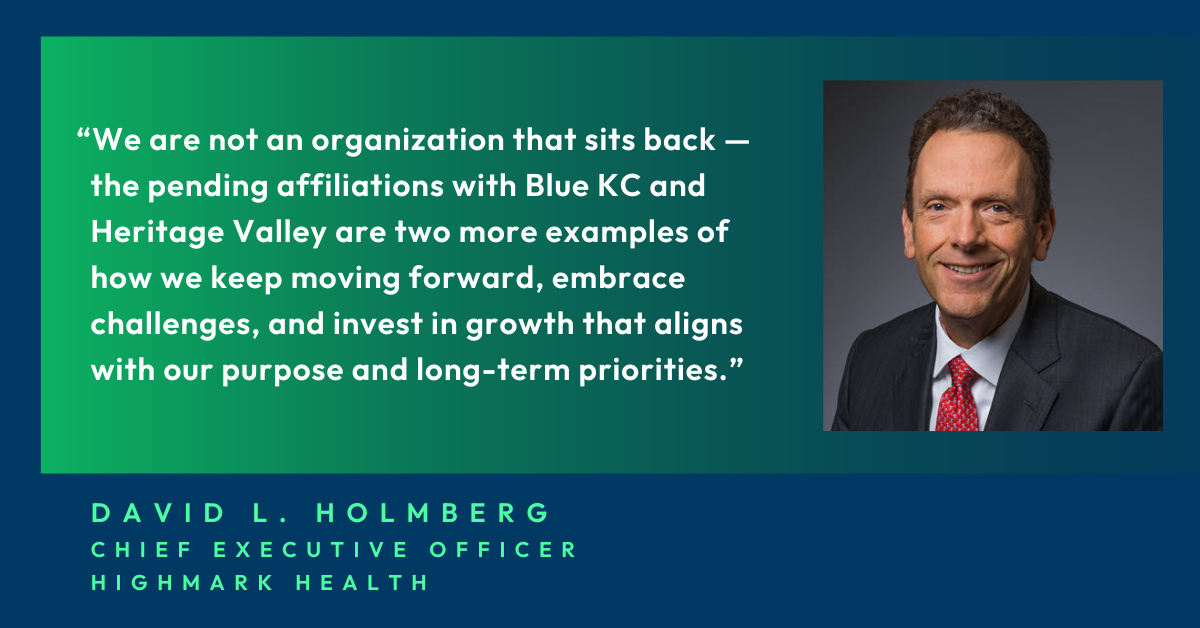
At the end of last year, we announced plans to grow our health plan business through affiliation with Blue Cross Blue Shield of Kansas City and expand our regional health system through an affiliation between AHN and Heritage Valley Health System, both pending regulatory approvals.
We also reported a significant third quarter operating loss for Highmark Health Plans. And, despite very strong financial performance from Allegheny Health Network and United Concordia Dental, we had a net loss for Highmark Health.
It’s no secret that the past couple years have been challenging for almost everyone in our industry. Nationally, higher-than-predicted usage of prescription drugs and health care services has resulted in three straight years of total medical costs rising 8% or more. Consumers, insurers and care providers have all been impacted by the policy changes, debate, and uncertainty around the ACA, Medicaid, and Medicare Advantage markets. And additional industry-wide challenges and cost pressures have come from ongoing labor shortages, the pace of technological change, and other factors.
None of that is expected to improve overnight. So some people might ask: Is this really the time to invest in growth?
I’m happy to explain why our answer is “yes.”
When an industry is in a challenging period, many companies take a defensive posture and try to ride out the storm. But challenging periods also create opportunities — and we have built an organization that is able and willing to act on those opportunities.
Highmark Health was created as a nonprofit parent organization after another strategic growth decision that many people questioned: Highmark, a health insurer, acquiring a fragmented hospital system facing bankruptcy and investing more than $2 billion in what is now Allegheny Health Network.
Very few organizations would have taken that risk. In fact, we were the first major insurer to invest in a provider system rather than the other way around.
Short term, that decision created a lot of work and pressure, and all the challenges of doing something no one had done before. But long term, it was clearly the right decision for our region and our organization. Several million AHN patients each year are glad we took that risk to ensure access to patient-centered, high-quality care in their community. And because we took that risk, AHN was there to play a leading role in getting our communities through the COVID pandemic.
Similarly, some questioned the risk we took on the ACA market. Insurers lost hundreds of millions of dollars due to market uncertainties and political shifts impacting the ACA in its early years. Many pulled out of the market altogether, but we saw an opportunity to make that market work. People also questioned our decisions to grow through affiliations with Blue plans in northeast Pennsylvania, and in western and northeastern New York. There were risks and challenges with those as well — but we took them on, and we feel good about helping to expand on the legacies of serving families, communities and businesses in those regions.
We are not an organization that sits back — the pending affiliations with Blue KC and Heritage Valley are two more examples of how we keep moving forward, embrace challenges, and invest in growth that aligns with our purpose and long-term strategic priorities.
“Strong and stable” may seem like a financial cliché, but what it means to Highmark Health is tangible and vitally important. It means that financially, operationally and culturally, we are built to weather any industry headwinds, or even a pandemic, while continuing to meet the needs of our customers and communities. It also means that when opportunities arise, we can act — whether that is investing in new technology, expanding care facilities, or pursuing something like the pending affiliations with Blue KC and Heritage Valley.
Being a nonprofit is part of our strength and stability. We don’t have the same short-term margin pressures as publicly traded health insurers or private equity-owned systems. Our “shareholders” are our members, patients, customers and communities. The return on investment they want is that we take good care of them and do it as affordably as possible.
Now, we're still disappointed with short-term losses, and you can be sure that we are doing everything we can to strengthen our financial performance. But as a nonprofit, and strategically, we also prioritize building and maintaining the longer-term strength and stability you see in our outside credit ratings, debt-to-capital ratio, cash on hand, and reserves.
Our diversified business model is another key aspect of our strength and stability. That starts with having both a payer and provider — some trends with a negative financial impact on one side have a positive impact on the other side. We gain additional resilience and revenue through diversified businesses in related areas like health technology, dental solutions, and stop-loss insurance.
I’ll add that “strong and stable” isn’t just about financials. Operationally, we have invested heavily to make sure that Highmark Health is positioned to be a leader in the next generation of technology. That includes the strength and stability that come from industry-leading internal expertise as well as long-term strategic partnerships with Google Cloud, Abridge, Spring Health, Noom, and others.
All of that also makes us an attractive partner for organizations like Blue KC and Heritage Valley. We bring that extra strength and stability, and we can also invest to build capabilities and innovate even when it requires a longer-term horizon.
Since Highmark Health was created in 2013, numerous organizations have taken a run at doing something transformational or disruptive in health insurance and health care. Many efforts, like the Haven joint venture, were abandoned when challenges arose or outside forces shifted. We’ve made many adjustments during that period, but our core purpose has remained very consistent: to transform our business, and collaborate with strategic partners, to build a better system of health, coverage and care for our customers and communities.
That purpose culminated in the creation of our Living Health model in 2020, the focus of a five-year business strategy that just ended — and of our next five-year business strategy as well. I have often told our team members that strategy is a series of “S” curves, and we have to handle those turns without flying off the road or losing sight of our destination. We’ve proven that we can adapt to anything that comes our way, but the destination is still Living Health and fulfilling our mission to “create a remarkable health experience, freeing people to be their best.”
That’s not always easy. You have to believe in what you're doing enough to stay the course, and find the extra determination needed to push through the obstacles that may arise.
Our commitment with Living Health is to create a whole new model of health, coverage and care that will provide better experiences and outcomes, be more affordable for consumers, employers and taxpayers, and be economically sustainable for organizations across the ecosystem. From the top leaders to the front lines in every area of our organization, you will find people who believe passionately in doing the work necessary to get to that destination.
That brings me full circle to the question of why, in the current industry environment, we would invest in growth and pursue the pending affiliations with Blue KC and Heritage Valley.
In the first five years of Living Health, we invested in technology like the My Highmark app and the underlying Living Health data platform. We invested in customer experience capabilities and research to better understand what members and patients want and value and how we can best help them. In western Pennsylvania, we continued to invest not only in AHN capabilities and facilities, but in a unique, value-based economic model.
We are confident that our model is working, and that it will work even better as it continues to evolve in the years ahead. We want to deliver Living Health to more people and take it into new markets like Kansas City. And certainly scale — having more members on our Living Health platform — is an important factor for the long-term affordability and sustainability of what we provide.
But “scale” can’t just be quantitative growth. We need to grow with like-minded organizations that share our values and ethics, and want to be part of the future we are building with Living Health. The pending affiliations with Blue KC and Heritage Valley are examples of doing just that.
The challenges our industry faces make the case for industry transformation stronger than ever. I am very optimistic about our ability to lead that transformation, and to innovate and solve real-world problems for our members and patients. I am more optimistic than ever about our vision and long-term strategy with Living Health.
And it is absolutely the right time to invest in making that vision a reality.
 David L. Holmberg is chief executive officer of Highmark Health, a $32 billion blended health organization that includes one of America's largest Blue Cross Blue Shield insurers and a growing regional hospital and physician network. Based in Pittsburgh, PA, Highmark Health's 47,000 employees serve millions of customers nationwide through the nonprofit organization's affiliated businesses, including Highmark Inc., Allegheny Health Network (AHN), HM Insurance Group, United Concordia Dental, Helion and enGen.
Holmberg is shaping the future of the healthcare industry by engaging with trade associations, regulators, peer organizations, strategic partners, and government to resolve critical health care issues. In 2016, Highmark Health sued the U.S. government in federal claims court, resulting in a 2020 Supreme Court ruling that affirmed that the federal government must fulfill its promises to preserve the trust that ensures the success of public-private partnerships, including the ACA marketplace. Read More
Want to learn more about Highmark Health's work to create a remarkable health experience through its Living Health strategy? Check out our Living Health Insights and Updates gallery page. Powered by UpContent, our gallery page provides a curated, regularly updated set of some of the best available articles, interviews, webinars, and other content about Living Health and related developments in our industry.



Highmark Health and its subsidiaries and affiliates comprise a national blended health organization that employs more than 42,000 people and serves millions of Americans across the country.
Entire contents © Highmark Health. All Rights Reserved.
Highmark Health is an independent licensee of the Blue Cross Blue Shield Association.
 Need to find info about providers, prescriptions, coverage, claims, ID cards, or health spending or savings accounts? If so, your Highmark member site is the place to go. (It’s separate from this blog.)