

 Share This
At healthcare organizations across the country, radiologists are in short supply. Meanwhile, imaging use is increasing 3-4% annually, due to several converging factors: aging population, expanded access to preventive care, and the clinical burdens created by growing chronic diseases.
The biggest factor of all in the ongoing surge in medical imaging might be the technology itself — an explosion of ever-advanced imaging systems in turn leads to new therapies that depend on imaging. The reliance on medical imaging is now central to orthopaedics, trauma, neurology, oncology, emergency medicine, and cardiovascular medicine, driving diagnosis, treatment decisions, and guided surgical intervention.
As the use of advanced modalities like CT and MRI continues to grow, the result is that it’s taking longer than ever for images to be read, with waits of weeks or even months for lower-priority images. That leads to frustration for patients and providers alike.
The task? Reduce low-value CT scans, MRIs and X-rays, to ease the burden on radiologists and mitigate the diagnostic bottlenecks.
“In the past, it was something that was on our to-do list,” says Jeffery S. Mueller, MD, chair of the AHN Department of Radiology and Imaging Sciences. “Today, it’s an imperative — we have to make changes.”
While diagnostic imaging studies are a vital element of modern healthcare, unnecessary or duplicative imaging waste both money and time, and can expose patients to additional doses of radiation or intravenous contrast. Studies find that low-value imaging services eat up billions a year in unnecessary expense for the U.S. healthcare sector.
Why do physicians order images when they may not be clinically indicated? Lots of reasons. For one, patients expect them, and may feel they are getting substandard care if a doctor doesn’t offer, say, a knee or lower-back MRI right away.
Some physicians believe they must practice defensively, either to confirm an already suspected diagnosis, or to stave off future malpractice litigation.
And some physicians just like doing things the same way they’ve always done them.
“Doctors like autonomy, and the ability to make decisions that they feel are in the best interests of their patients,” Dr. Mueller says.
Finally, there’s one more reason, which has become prevalent over the last decade — doctors order images because the electronic health record system tells them to.
When a patient exhibits a particular set of symptoms, the electronic health record (EHR) recommends a series of default orders. If a patient presents with chest pain, for example, the EHR suggests an order set that may include labs, EKG testing, imaging and a cardiology consult.
In an environment where every minute matters, it’s easier — and faster — to go with the recommended orders. But in digging into AHN’s default order bundles, a workgroup led by Dr. Mueller found that, in some cases, the EHR system was recommending images too liberally.
In other words, the default orders were out of alignment with current best practice guidelines, and made it too easy for physicians to order imaging, even if it wasn’t clinically indicated.
“It was especially noticeable in emergency department (ED) stroke care,” Dr. Mueller says. “Our CT utilization for stroke was higher than comparable EDs across the country.”
AHN was able to determine that by examining deidentified claims data made available through its parent company, and through other subscription registries.
In stroke medicine, time is brain, and the clinician’s instinct is often to order imaging scans as quickly as possible.
Yet it’s not always needed. If a patient arrives shortly after a suspected stroke — say, within 24 hours — the full battery of emergency diagnostics would be warranted, including head CT scan and CTA (computed tomography angiography) of the head and neck.
But if the patient’s stroke occurred three days ago, there’s typically no need for immediate advanced diagnostic ED imaging. In that case, the patient would simply be admitted to the hospital, and imaging would be ordered as needed.
So the workgroup — which also included leadership from AHN’s department of emergency medicine, as well as its quality, trauma, and stroke medicine teams — agreed to rewrite the default ED order sets.
“When the order sets were changed, physicians have to pause and think about it, and order images manually,” Dr. Mueller explains.
After the EHR change, the results were almost instant — a 27% reduction in stroke CT orders for suspected stroke patients across AHN. Allegheny General Hospital, AHN’s flagship critical care and trauma center, has seen a further 22% reduction from 2025 to 2026 in CT of the head and neck.
That drop in CT orders for stroke patients alone contributed to a drop in overall emergency department CT orders across the network. In 2025, AHN saw a 3% drop in CT orders in the emergency department, reversing what had been a double-digit growth trend. In 2026 year to date, the reduced CT orders are trending in the same direction.
Dr. Mueller’s task force is now looking into other opportunities. Sepsis, for example, is prone to over-imaging. Physicians use CT scans to identify infectious focal areas. Early detection of sepsis is critical, and delays in treatment can lead to septic shock and organ failure. But in cases where the source of infection is already clear, or in those not showing clinical deterioration, follow-up CTs may not improve outcomes.
As unnecessary images are weeded out of the system, savings stack up. Reducing emergency department CT scans down to AHN’s target quartile would eliminate nearly 12,000 CT scans in a calendar year, saving millions for the health system, and millions more for the patients and insurers footing the bill.
While the money saved is important, it’s a secondary consideration compared to the need for faster reads and improved access.
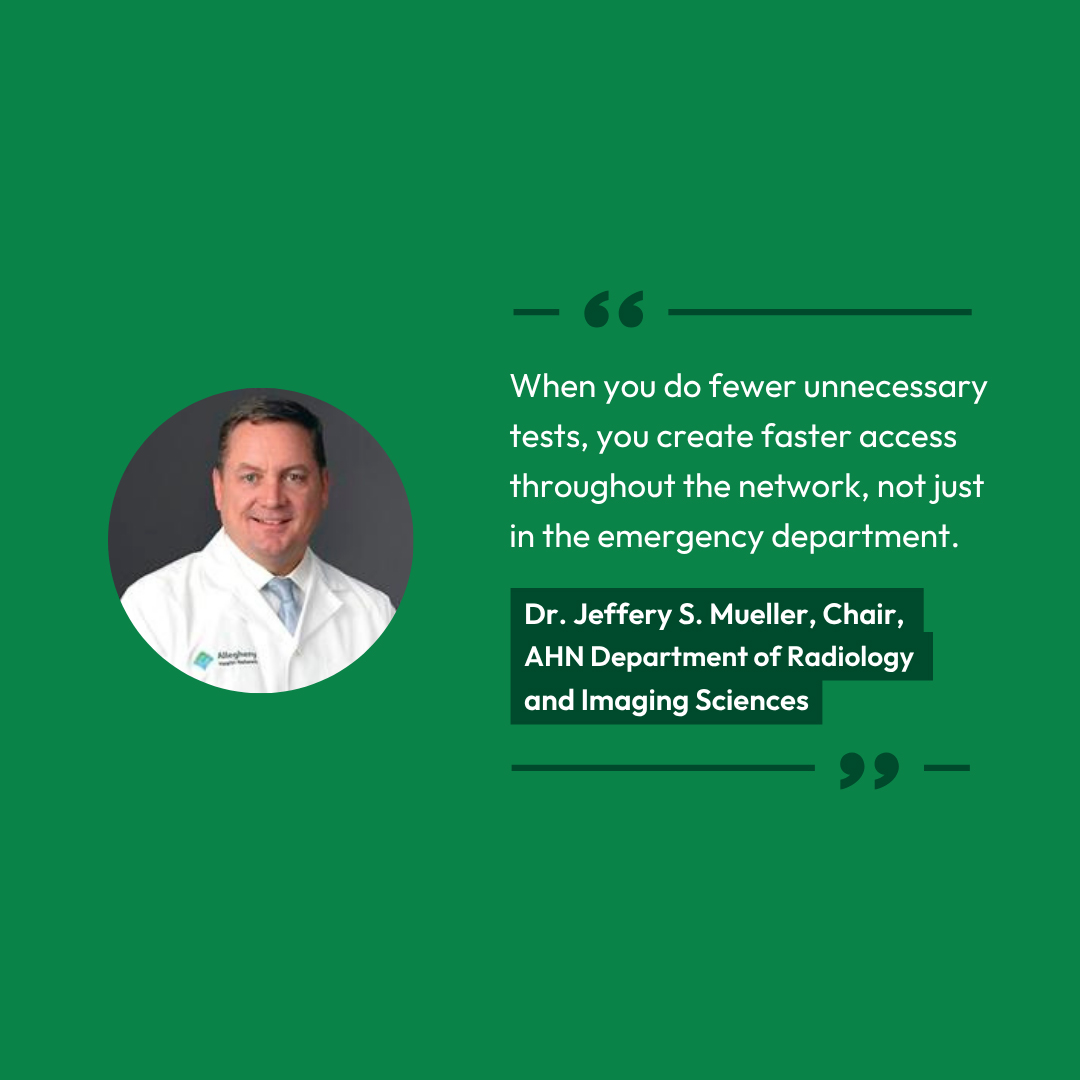
“When you do fewer unnecessary tests, you create faster access throughout the network, not just in the emergency department,” Dr. Mueller points out.
The same radiologists who read ED images are also tasked with reading outpatient image orders — meaning if there are fewer emergency department images to look at, the CTs and MRIs ordered by your neurologist, oncologist or orthopaedic surgeon will be read more quickly.
As with all utilization and cost-management initiatives, the goal with AHN’s CT reduction effort is to strike the perfect balance.
“We want to ensure appropriate utilization, without negatively impacting patient care outcomes in any instance,” Dr. Mueller emphasizes.
 Jeffrey S. Mueller, MD, is the chair of AHN’s Department of Radiology and Imaging Sciences. A board-certified radiologist, Dr. Mueller has held numerous leadership positions within the AHN imaging department, including vice chair, operations officer, quality officer, division director of Cardiothoracic Imaging, and clinical director of the Lung Cancer Screening Program.
Specializing in cardiothoracic imaging, Dr. Mueller’s current areas of clinical expertise include thoracic and cardiac imaging, lung cancer screening, high-resolution chest CT, and cardiac CT. As radiology chair, Dr. Mueller leads a team of radiologists, technologists, nurses, and support staff providing vital imaging services and minimally invasive image-guided procedures across western Pennsylvania and New York.
Dr. Mueller received his medical degree from the University of North Carolina at Chapel Hill and completed his residency at the University of Minnesota Medical Center. Following his residency, he completed fellowships in cardiothoracic radiology from the University of Maryland Medical Center and in breast imaging at AHN Allegheny General Hospital.



Highmark Health and its subsidiaries and affiliates comprise a national blended health organization that employs more than 42,000 people and serves millions of Americans across the country.
Entire contents © Highmark Health. All Rights Reserved.
Highmark Health is an independent licensee of the Blue Cross Blue Shield Association.

 Need to find info about providers, prescriptions, coverage, claims, ID cards, or health spending or savings accounts? If so, your Highmark member site is the place to go. (It’s separate from this blog.)