

 Share This
Our vision is a world where everyone embraces health. In our Remarkable Leadership series, we talk with people who are making that vision a reality by leading the work to create a new system of health, empower our customers and communities, and better support every individual's health journey.
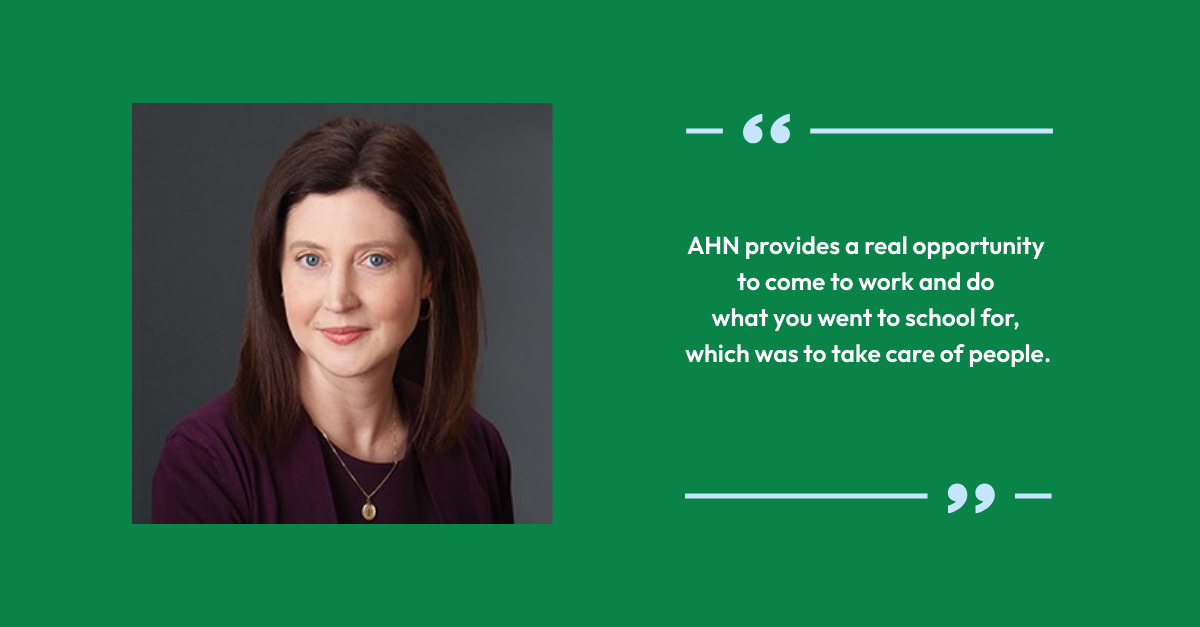
As president of Allegheny Clinic and chief medical officer of Allegheny Health Network, Bethany Casagranda, DO, MBA, wears a lot of hats and fulfills a lot of roles: She’s a problem-solver. She’s a relationship-builder. She’s a mentor. She’s the executive voice for AHN’s 2,500 staff physicians.
And, notably, she’s the first woman to serve as CMO for the network and president of the clinic, AHN’s physician organization.
“Every step of the way in my career, I have been the first woman in the role,” Dr. Casagranda says. From being the first woman to serve as division director of orthopaedic imaging at AHN Allegheny General Hospital, to being the first woman to chair the AHN radiology department, she relishes plowing the path for women physicians behind and beside her.
“At the time, when you looked across the country, there were 10 female radiology chairs out of the 120 academic institutions,” Dr. Casagranda says. The absence of women chairs surprised her. Earlier in her career, it made sense in a way — orthopaedic radiology had been a male-dominated field. But at the radiology chair level? She thought there’d be more, especially given that women now make up more than half of all U.S. medical students.
“I have two girls. So by nature, I want to kind of push those obstacles down so that, whatever paths they choose in their life, maybe they’re not the first woman, but one of many remarkable female leaders.”
In the following Q&A, Dr. Casagranda discusses her career journey, her role as president of Allegheny Clinic and CMO, and the Living Health clinical model, among other topics. The questions and answers have been edited for clarity and length.
Bill Toland: You were appointed president of Allegheny Clinic and CMO of Allegheny Health Network at the end of 2024. What have been the biggest surprises after your first several months on the job?
Dr. Bethany Casagranda: I would have to say that I was most surprised about how quickly culture can be elevated with change of leadership. When (AHN president) Mark Sevco arrived, he brought a great deal of energy and excitement to the physician organization and the entire AHN team. It's just been amazing how he chooses to communicate, how often he chooses to communicate, the way he holds town hall meetings.
He’s trying to reach every single person in our health system. And I think that’s very unique to him. It isn't really about old leadership and new leadership. It’s about unique leadership. And I find him to be the right, unique leader at the right time for us.
Bill Toland: Are there growing pains associated with breaking in several new executive leaders at the same time?
Dr. Bethany Casagranda: Sure. I think that when you have two new leaders in place, the challenges are that we’re learning our jobs at the same time as we’re learning about each other. It’s a broader scope of work for both of us. So not only are we learning how to work with each other, but we’re learning, really on the job, how to do our jobs.
We are fortunate to be surrounded by people who have a lot of institutional knowledge. Brian Devine, our chief financial officer, has been in this role for a few years, and has really helped stabilize the new leadership that’s coming in. Because although we have a lot of energy, that energy needs to be guided with a lot of historic information.
Bill Toland: The imaging and radiology department works across all specialties, in every hospital. How did your old role — chair of radiology — prepare you for this one?
Dr. Bethany Casagranda: I think that having the opportunity to be chair of radiology for eight years — it’s the type of department that is woven throughout the health system, inpatient as well as outpatient centers — I built a lot of relationships with the leaders of the hospitals and with the outpatient leaders, and across the specialty institutes.
So I’ve learned a lot from those individuals about how they work, and they've learned a lot about me over the years. There’s a great deal of trust in those relationships. As I came into this role, I felt I had an advantage in that my optics were always much more system-focused than they were hospital-focused or institute-focused.
Bill Toland: What have you been hearing from AHN team members during your first six months?
Dr. Bethany Casagranda: We need to make sure that we are creating a workplace culture that allows our people to develop and grow, through defined career ladders and other opportunities external to our health system. It’s something that a lot of people are hungry for right now. Not only our physicians, but our nurses, our technologists, our APPs — there are so many people who want to see opportunities to continue to learn. Which is great news because, in our health system, we have many forever learners.
That’s something that keeps ringing true over and over again, that people want to grow in this space. They want to dedicate themselves to the health network and to our patients.
Bill Toland: You mentioned APPs (advanced practice providers), such as Certified Registered Nurse Practitioners and Physician Assistants. In other states, they have more independent practice authority than they do in Pennsylvania. What do you think about the current push to expand the independent practice authority of APPs?
Dr. Bethany Casagranda: My predecessor, Dr. Donald Whiting, saw them as a critical asset to our health system, and so do I. There are shortages in so many specialties, and in primary care, when it comes to physicians, and APPs play a critical role in relieving those shortages.
There were old models where care teams were physician-led only, and the hierarchy of medicine was very stringent. But what we have learned along the way is, especially in the ambulatory space, we couldn’t run our panels, we couldn’t see the number of patients that need us, and we couldn’t provide access to our communities without our APPs.
They’re true partners in care. As the government and regulatory conversations continue regarding the different scopes of practice, we are always striving for our APPs — and our other clinicians — to be able to work at the top of their scope.
Bill Toland: Do you feel any additional responsibility being the first woman at AHN to serve as president of the Allegheny Clinic and CMO?
Dr. Bethany Casagranda: Yes, but I'm pretty proud to carry that burden.
First, I want to say that I needed a lot of support from my colleagues to be able to sit in this role, many of whom are men. But I do think there is an extra burden — I have such high expectations for my team and for myself, and being the first female in a role, you don’t want to trip on that, right?
I hope to be more visible as a female physician leader, so that others will see more opportunities — not just in the C-suite, but also more women serving as chairs of departments, program directors and division directors.
Bill Toland: Given all those shortages you mentioned, what is your elevator pitch for potential AHN recruits?
Dr. Bethany Casagranda: Whether it’s for CRNAs, APPs or physicians, my elevator pitch would probably be to come to somewhere that always puts the patient first.
And I think that our Living Health clinical model is definitely putting the member first, the client first, the patient first. I mean, it sounds so cliche to say, “Well, the patient is first” — but for many of us who have worked in other health systems, that actually isn’t always the driver.
So I think AHN provides a real opportunity to come to work and do what you went to school for, which was to take care of people.
Bill Toland: How does that Living Health clinical model work in a practical way, that patients can see and understand?
Dr. Bethany Casagranda: It’s about whole-patient “well-care,” across every touchpoint.
For instance, in the old models, your PCP or your pulmonologist may say to you, “Are you smoking? How much are you smoking? Here’s a smoking cessation program.”
But what we want is for you to go in for your colonoscopy and your GI doc says, “Hey, are you smoking?” We’re trying to have providers think outside of their box when they have an opportunity to capture a patient’s history. Because we want you to live the healthiest life you can, and we recognize you may not make it to your PCP, or in some cases you may not have one.
So that's the movement that we’re trying to capture. And I will say it’s been so encouraging to see physicians, even those of us that are mid-career or later-career, be able to change how we engage with our patients. The Living Health clinical model is teaching all of us more ways to keep our patients healthy.
Bill Toland: And keeping people healthy under this model extends beyond the hospital’s four walls, correct?
Dr. Bethany Casagranda: Of course. As a patient, it might be best for you to be seen by one of AHN’s clinical programs. Or it might be best to provide them access to virtual physical therapy or virtual mental health programs, to truly empower patients to take care of themselves.
This is transformative for health care, and empowering for our population. You always don’t have to go through the provider. Instead, the provider and the health insurer are collaborating on the best ways to keep you healthy and provide you with affordable, accessible health care options, in the way that works best for you.
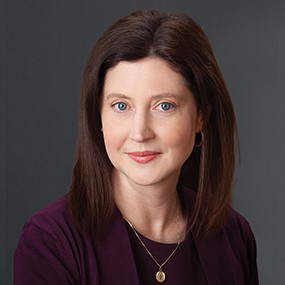 As Allegheny Health Network’s chief medical officer, Bethany Casagranda, DO, MBA, is AHN’s senior-most clinical executive and the leader of AHN’s medical staff of 2,500 employed and affiliated doctors. She is also president of AHN’s physician organization, the Allegheny Clinic, one of the state’s largest physician groups, employing more than 1,400 physicians.
Prior to being named CMO, Dr. Casagranda served as chair of AHN’s Imaging Institute from 2017 onward. In that role, she advanced high-quality care, leveraging state-of-the-art imaging technology across the network’s expansive system of hospital and ambulatory imaging facilities. Under Dr. Casagranda’s leadership, the AHN Imaging Institute experienced significant growth and investment, both in terms of its facilities as well as its clinical staff, which grew from 28 to 124 physicians during her tenure. Additionally, the Imaging Institute recently completed a four-year journey to designate all AHN imaging facilities as Diagnostic Imaging Centers of Excellence (DICOE), the gold standard for imaging program quality, as recognized by the American College of Radiology.
In her capacity as CMO, Dr. Casagranda serves as the lead clinical executive for AHN’s employed physician organization and AHN hospital medical staffs. She will also play a key role in AHN’s ongoing clinical transformation, including integrated efforts between AHN and Highmark Health to further develop and execute the organization’s Living Health clinical model, which advances medical protocols through evidence-based high-quality care redesign.
Dr. Casagranda earned her undergraduate degree from Washington and Jefferson College, earned her medical degree from the Philadelphia College of Osteopathic Medicine, and completed her residency and fellowship training at UPMC, where she remained on staff and faculty until 2013, when she joined AHN. At AHN, she has held a variety of leadership positions, including program director of the Radiology Residency program, Musculoskeletal (MSK) fellowship director, MSK division director, and most recently, professor and chair of the Department of Radiology. Her clinical specialty is musculoskeletal radiology, and she is certified by the American Board of Radiology in diagnostic radiology.



Highmark Health and its subsidiaries and affiliates comprise a national blended health organization that employs more than 42,000 people and serves millions of Americans across the country.
Entire contents © Highmark Health. All Rights Reserved.
Highmark Health is an independent licensee of the Blue Cross Blue Shield Association.

 Need to find info about providers, prescriptions, coverage, claims, ID cards, or health spending or savings accounts? If so, your Highmark member site is the place to go. (It’s separate from this blog.)