

 Share This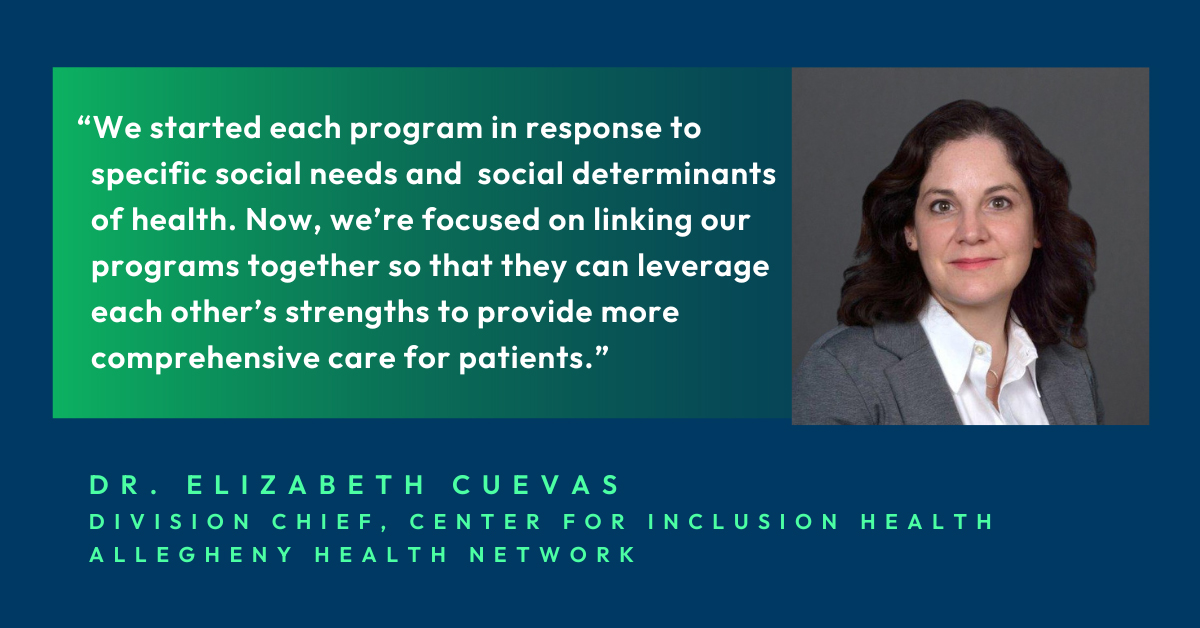
In 2014, AHN internal medicine physicians Dr. Elizabeth (Liz) Cuevas and Dr. Patrick (Pat) Perri began building a team of health care professionals dedicated to caring for marginalized populations that would help set new standards and drive meaningful change in the city of Pittsburgh and beyond.
At the time, there were some disparate programs in the community addressing health issues like substance use disorder and homelessness, but Dr. Cuevas and Dr. Perri dreamed of something more connected and transformative, something capable of catalyzing system-level change, while providing inclusive, comprehensive care and services for individuals often excluded from meaningful health care access and equitable health outcomes.
Today, the AHN Center for Inclusion Health (CIH) aims to transform health care through the development of innovative clinical care models, advocacy, training and research to better serve all people, including those experiencing social and health exclusion. CIH’s many unique programs are rooted in a harm-reduction model, designed for and with people experiencing exclusion, to meet them where they are, both physically and psychologically. The center provides low-barrier services in traditional and non-traditional settings, including in medical clinics and hospitals, on the streets, in the jail, on mobile units and via telehealth. CIH programs address health issues related to addiction, food insecurity, HIV/AIDS, homelessness, gender diversity, incarceration, intimate partner violence, transgender health, and immigrant and refugee health.
Dr. Cuevas serves as the center’s division chief and Dr. Perri serves as its medical director. In celebration of all that CIH has accomplished over the past decade, we sat down with them to discuss those milestones, what the future holds for the program and the challenges that remain in helping every member of our community live their best, and healthiest lives.
Candace Herrington: Let’s start by talking about the concept of inclusion health and how that evolved into the Center for Inclusion Health at AHN.
Dr. Pat Perri: When Liz and I came back to Pittsburgh from our time in Boston with the Boston Health Care for the Homeless Program, we were eager to create similar but expanded clinical programming in Pittsburgh. In addition to working with populations with whom we were already familiar, such as those experiencing homelessness and substance use disorders, we envisioned a broader, networked effort capable of serving other kinds of excluded groups and leveraging the lessons learned to create important system-level changes.
One of the first people we were introduced to was Stuart Fisk who, at the time, was leading the Positive Health Clinic at AHN for persons living with HIV. In talking with Stuart, it didn't take long to see that we were kindred spirits in our health equity idealism and approach to population health. We spent time learning more about the Positive Health Clinic, including its highly effective patient-driven model, harm reduction philosophy, team structure and values. It was something we could build upon to reach more people.
Meanwhile, a few of my colleagues in the UK whom I had met through my work with the Street Medicine Institute and the International Street Medicine Symposium, were working to bring together public health programming and epidemiologic research under a new umbrella called “inclusion health.” Together, we fleshed out this novel concept of inclusion health, defining it as a service, research and policy agenda that aims to prevent and redress health and social inequities among the most vulnerable and excluded populations. This work was later highlighted in a series of papers published in The Lancet. It marked the first time that inclusion health and its underpinning epidemiologic research had been formally described in medical literature.
So in creating this new program at AHN, it felt natural to call it the AHN Center for Inclusion Health.
Maddie Goerl: How do social needs drive the program development at CIH?
Dr. Liz Cuevas: Looking back to when we started, one of our very first programs was focused on addressing homelessness. Pat and I had a lot of experience with this in Boston and, as we delved into the homeless community here in Pittsburgh, we started to uncover many other needs that existed like addiction, food insecurity and more. We started to realize that there wasn’t much that existed within health care to address these needs, which is what kick-started the development of programs within CIH that target specific challenges people face.
Many of our programs have been born out of the recognition that a population tends to encounter common obstacles in accessing the care they need. Our post-incarceration clinic, known as the RIvER Clinic, is one of the most recent examples. It was created in response to an absence of care for individuals once they are released from jail which contributes to greatly increased morbidity and mortality during that transitional period.
What we're aiming to do now is tie all of our programs together. We started each program in response to specific social needs and social determinants of health. Now, we’re focused on linking our programs together so that they can leverage each other's strengths to provide more comprehensive care for patients and reduce systemic barriers.
Dr. Liz Cuevas: The goal I think for the Center for Inclusion Health is to transform health care. We try to bring populations of patients into the health care system, those who had traditionally been excluded from care. For one reason or another they found those doors to the health care system closed. And what the center tried to do was to open those doors for people.
Dr. Heather Richards: By putting a name, giving a face, a voice, to people that really needed to be allowed to talk, tell their story and what’s going on in their life, and then be given the proper respect and treatment that they need. We’ve developed 12 programs I think it is in CIH over the past 10 years. We had one employee on day one, right, but now we have programs for many different underserved individuals.
Dr. Liz Cuevas: I would remember we’d get together in a conference room and, one by one, we just started tackling these various issues, and we grew and grew and grew.
Kristi Seemiller: To see the way that programs have evolved and grown and the amount of staff we’ve been able to add to really hit all of those gaps, and to keep finding more gaps that we’re so interested in making sure we close.
Dr. Heather Richards: With the addition of those individuals and boots on the ground, that people know who we are everywhere. Out on the streets, they know who we are, they know how to access us, they know that they can come up and talk to us, that we can try to provide them services exactly where they are.
Dr. Liz Cuevas: Initially with homelessness and housing insecurity and developing a street team, but then we quickly evolved to substance use care, to food insecurity and having our Healthy Foods Centers. We incorporated transgender care into our services, as is immigrant health. We also have programs in intimate partner violence and post-incarceration care. We’re doing a lot in the mobile health world right now, and we just started a collaboration with the Veterans Place. A lot of those individuals are housing insecure or having housing instability, and so we’re starting to understand what the health care needs are for that population and then develop services for them.
One exciting collaboration we have is with the Humane Animal Rescue of Pittsburgh, or HARP. By providing both medical and veterinarian care all together in the same space at the same time allows us to really capture people.
Kristi Seemiller: There is always something else that we’re striving toward. We’re not okay with complacency, we’re not okay with leaving it where we are, we’re always going to find a way to try to include those people that need us.
Dr. Liz Cuevas: We think of ourselves as an innovator and incubator of ideas. One of these ideas is not so new, but it hasn’t been used in health care in a long time in systems, and that’s of community health workers.
Dr. Heather Richards: Some of our community health workers are really there, boots on the ground, directly in front of them, and have some similar lived experiences that they can talk about, that they can establish common ground and perhaps develop that friendship or that baseline relationship that’s going to get them one step closer to the office.
John Whigham: I am that guy that wakes up and then I go to bed and I’m grateful to be alive, because I shouldn’t be here. I always used to ask myself an interesting question about entering into recovery — like, why did I “get it,” and four years later why do I have it? I don’t know, I don’t know what the answer is to that, right, but I know that I can offer it, and then offer it again, and again and again. It’s a necessity, born out of that need to do that, because what was done for me I can give back to someone else.
Dr. Heather Richards: When I get people that come back to me and say, you were the only person that listened, I am coming back to AHN because you and your team treated me with the respect that I deserve — that’s huge to me, that’s why I continue to do what I do.
John Whigham: I was working with a gentleman who was sleeping outside, sleeping in the rough, and I had watched him in a very short period of time latch on to that help that was presented to him, utilize it, and start to turn his life around in the sense that he was no longer unstably housed and going to college for culinary school. So — it’s just a beautiful sight to behold.
Dr. Liz Cuevas: All of our employees do this work, not because it’s a job, they do it because this is the kind of way they want to dedicate their lives. This is where they find their joy, this is where they find their inner fulfilment. And it’s truly, I think, what sets us apart.
Maddie Goerl: Thinking back to when CIH launched in 2014, in what ways is it what you envisioned? How is it different?
Dr. Pat Perri: With respect to our team, we envisioned attracting talented clinicians eager to work in the health equity space within a health system. We were confident we could make an impact within AHN and the Pittsburgh community, and potentially even serve as a model for other health systems.
Over the last 10 years, some amazing people have been drawn to this work at CIH. Many of our staff members have lived experiences themselves, being members of the communities that we serve and encountering the kind of exclusion that we work to uproot. Their experience has become incredibly powerful and valuable in guiding CIH on this path.
We’ve also attracted some incredibly diverse and talented clinicians who have trained and worked in some of the very best population health programs in the country. They are outstanding caregivers who are highly committed to this work with a unique ability to think creatively and passionately about building more effective care models in the pursuit of health and social justice.
I think we expected to be able to build a strong team — but not to this degree. We’ve also been surprised by how quickly CIH has grown. I don't think we could have imagined that in just 10 years, this new enterprise would become so robust and integral to our health system, nor that there would be so many different programs operating successfully under the umbrella of CIH.
Lastly, we didn’t anticipate having so much impact so far outside of our region. We have a steady stream of organizations coming to us from other states and countries who are interested in understanding how they can create similar programs in their own communities and within their own institutions. That's been wonderfully rewarding and humbling.
Candace Herrington: Are there any “aha” moments that you can point to when you really started to feel like CIH was making a difference?
Dr. Liz Cuevas: There have been a few “aha” moments, but one change really stands out for me.
When you talk about inclusion health, I think in theory most people are on board with it. We think, “of course, we are human beings, and we should help each other out.” But in reality, there are real challenges when you bring people into settings where they haven’t historically been accepted for who they are.
These individuals may be experiencing a mental illness or homelessness, they may not take all their medications as prescribed, and they generally tend to have a higher level of needs. There can be a lot of discomfort, especially at the beginning of the patient/provider relationship. As a result, providers were not always aligned with what we were trying to do.
I can't pinpoint a time when this “switched,” but, a few years after CIH was created, we started to get calls from providers across AHN asking for our help. They began inviting us to their offices and hospitals to help educate them and their staff about excluded populations and the services we offer. Suddenly, people started to say, “Oh, I know why you exist now and thank you for helping us and the patients we want to serve better.” It was a gradual change, but it’s something we look back on that shows us how far we’ve come.
Candace Herrington: The nature of inclusion health work can be challenging and difficult at times. Can you speak to what continues to propel the team forward?
Dr. Liz Cuevas: To put it simply, this isn’t easy work. Sometimes it’s like building an airplane while you’re flying it. But it is necessary work, and our team truly believes in the mission and vision of CIH.
We recognize that many experiences we face can be a source of stress and burnout. We talk directly with our team about the secondary trauma that can arise when bearing witness to other people’s stories and experiences of trauma.
We are also very intentional about recognizing the hard work of our staff, and I think that has paid off in terms of their loyalty to CIH. But I think, ultimately, the people who call CIH their home do so because they believe in the work. It is purposeful work that is mission-based and meaningful. They are inspiring individuals who are continually motivated by the patients they serve who fuel them to continue moving forward, even though the path ahead can be difficult.
Maddie Goerl: Looking toward the future, how do you anticipate CIH will evolve in the next decade?
Dr. Liz Cuevas: I think CIH will continue to grow. I don’t know if that will be just in terms of number of programs and staff members, but it will definitely grow in its impact within and outside of our health system.
One way that I think we’ll be able to accomplish that growth in impact is through the launch of a model we’re calling “One CIH.” As part of the model, each patient can enter any of our CIH “doors” and receive a host of services and a range of clinical programs that meet different needs. In this way, patients will receive more comprehensive, holistic care from CIH caregivers, from providers and specialists across AHN, and from our community. Over the next 10 years, we hope that One CIH becomes a well-established principle of care.
Candace Herrington: Any closing thoughts?
Dr. Liz Cuevas: We are grateful for the support given to us by both AHN and Highmark. Without their openness to trying out new ways to provide health care, CIH would not have been a possibility.
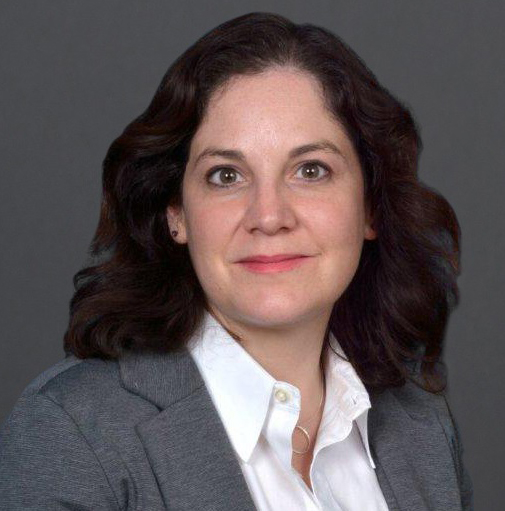 Dr. Elizabeth Cuevas received her Bachelor of Science degree from the University of Notre Dame and her M.D. degree from the University of Pittsburgh with a special concentration in Health Care to Underserved Populations. She completed her residency training in Internal Medicine at the Massachusetts General Hospital, where she was also enrolled in the Primary Care Track.
After residency, she took a dual appointment in the outpatient primary care academic practice, Internal Medicine Associates, with the Massachusetts General Hospital and in various clinics serving the homeless with the Boston Health Care for the Homeless Program.
Dr. Cuevas moved to Pittsburgh in 2011, joining the staff at Allegheny General Hospital. Her clinical time is devoted to the education of Internal Medicine Residents at AGH, working as a preceptor in the outpatient resident clinic as well as an attending on the inpatient teaching teams. She also serves as Core Faculty for the Internal Medicine Residency Program.
Dr. Cuevas is one of the founding members of the Center for Inclusion Health at AHN. Current projects with the Center for Inclusion Health include: integration of behavioral health into the primary care setting, Patient-Centered Medical Home (PCMH), and implementation of screening for social determinants of health. She currently serves as division chief for Center for Inclusion Health, director of the CIH Track in the Internal Medicine Residency Program, and director of Primary Care Transformation for the residency clinics.
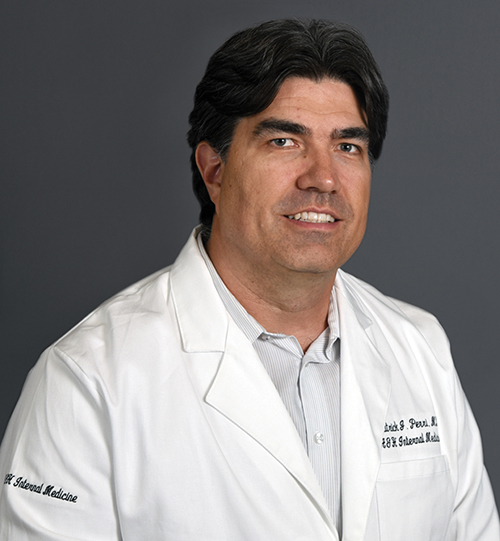 Dr. Patrick Perri received his undergraduate degree from the University of Notre Dame and M.D. degree from the University of Pittsburgh with a special concentration in Health Care to Underserved Populations, followed by residency training in Internal Medicine-Primary Care at Massachusetts General Hospital.
After completing his residency, Dr. Perri served as Instructor of Medicine at Harvard Medical School and Assistant in Medicine at Massachusetts General Hospital while working as a clinician on the Street Team of the Boston Health Care for the Homeless Program.
He currently serves as medical director of the AHN Center for Inclusion Health and is active as a clinician educator on the faculty of the AHN Internal Medicine Residency Program. Within the Center for Inclusion Health, he has held leadership roles with the Urban Health Outreach program, Street Medicine Team, Inclusion Health Inpatient Consult Service, Medical Respite Program, and Inclusion Health Residency Training Track.
In addition to his clinical and teaching activities, Dr. Perri directs the Street Medicine Institute — an international non-profit organization dedicated to improving access to health care services for people living on the streets throughout the world — and serves as educational director of the annual International Street Medicine Symposium. During more than 20 years of work with homeless and other socially excluded populations, Dr. Perri has developed and implemented a number of internationally recognized innovations in homeless health care delivery and medical education, including a homeless inpatient consultation service model and a comprehensive curriculum in homeless health care.



Highmark Health and its subsidiaries and affiliates comprise a national blended health organization that employs more than 42,000 people and serves millions of Americans across the country.
Entire contents © Highmark Health. All Rights Reserved.
Highmark Health is an independent licensee of the Blue Cross Blue Shield Association.

 Need to find info about providers, prescriptions, coverage, claims, ID cards, or health spending or savings accounts? If so, your Highmark member site is the place to go. (It’s separate from this blog.)